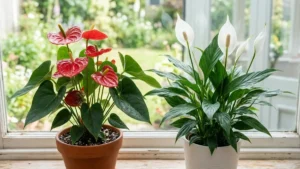
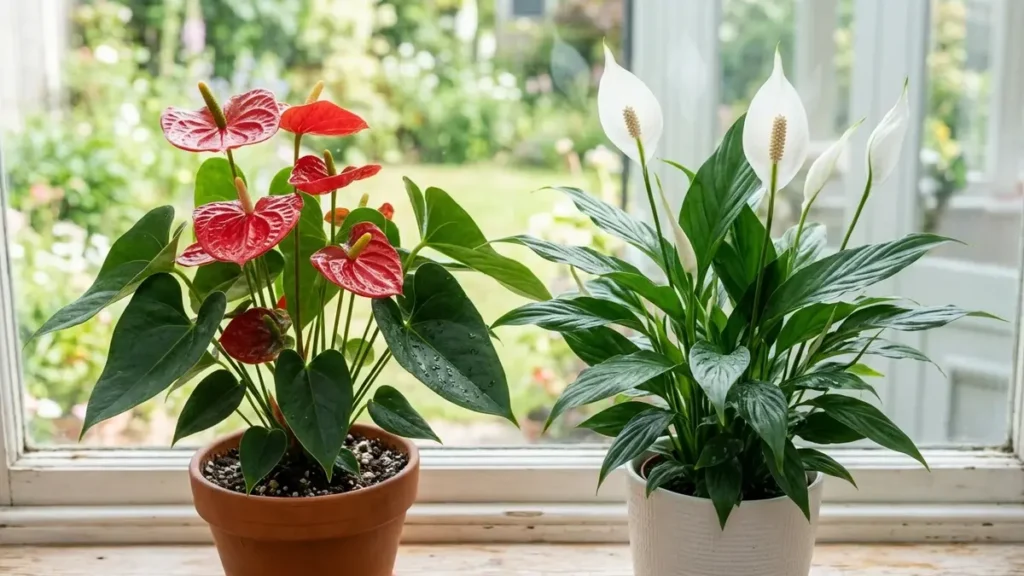
Have you seen a plant with bright red, heart-shaped flowers labeled as a red peace lily? You might be surprised to learn that it’s usually an anthurium, not a true peace lily. The difference between a red peace lily vs anthurium can be confusing because both plants belong to the same plant family and are popular indoor houseplants. However, they have different features, growing needs, and care requirements.
In this guide, you’ll learn how to tell these two plants apart by their flowers and leaves, understand their watering and lighting needs, and find out which plant may be easier to care for in your home.
Quick Answer: Is a Red Peace Lily an Anthurium?
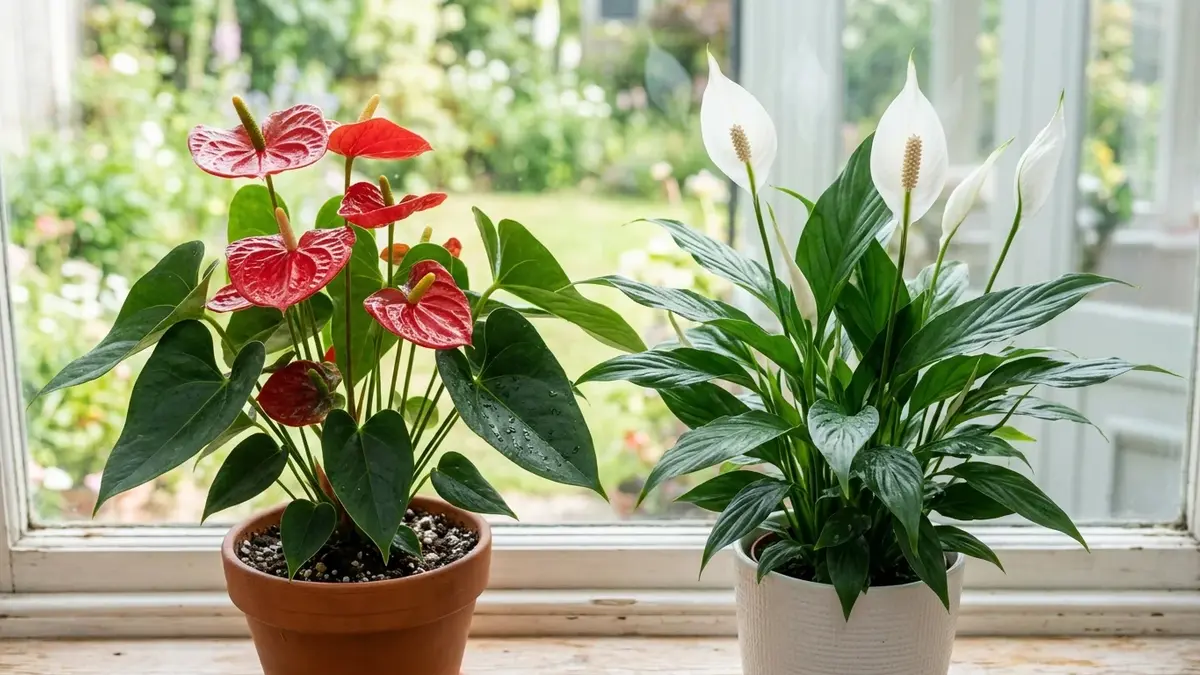
Yes, when a seller uses the name “red peace lily,” the plant is usually an anthurium (Anthurium species), not a red-flowered peace lily (Spathiphyllum species). Anthuriums often have glossy red, pink, or other colorful spathes, while familiar peace lilies produce white spathes that may turn green with age. Both belong to the arum family, Araceae, but they need somewhat different care.
Key Takeaways
- The short answer: A plant sold as a red peace lily is usually an anthurium.
- Look at the bloom: Anthuriums have thick, waxy, often heart-shaped spathes; peace lilies have thinner, softer white spathes.
- Check the leaves: Anthurium leaves are often glossy and heart-shaped, while peace lily leaves are usually longer and more pointed.
- Soil matters: Anthuriums generally benefit from an airy mix containing materials such as bark and perlite. Peace lilies usually do well in a moisture-retentive but well-draining houseplant mix.
- Bloom length differs: Individual anthurium spathes can last for months under suitable conditions; peace lily spathes commonly last weeks.
- Both need light: Bright, indirect light supports healthy growth and flowering in both plants, although peace lilies tolerate lower light better.
- Keep pets away: Both plants contain insoluble calcium oxalate crystals and are toxic to cats and dogs if chewed.
You’re shopping for a houseplant when you spot a beautiful red flower at the garden center. The label says “red peace lily,” and the price seems reasonable. Its glossy leaves and bright red bloom look familiar enough, so you take it home and follow the peace lily care instructions you already know.
Three weeks later, the leaf edges begin to curl, the soil stays wet longer than expected, and the plant doesn’t look as healthy as it did in the store. You wonder whether you’ve made a mistake with watering or light.
There may be another explanation: your red peace lily is probably an anthurium, not a true peace lily.
The two plants belong to the same botanical family and share some growing needs, but they aren’t the same plant. Anthuriums usually have thicker, waxy, colorful blooms and benefit from a chunkier potting mix. Peace lilies have softer white blooms and are generally more forgiving of lower light.
Once you know which plant you own, choosing the right soil, light, and watering routine becomes much easier. Let’s look at how to tell them apart and care for each one properly.
Red Peace Lily vs Anthurium: Key Differences at a Glance
The easiest way to compare these plants is to look at their blooms, leaves, roots, and growing needs together. A single feature may not be enough to identify every cultivar, but several clues usually make the answer clear.
| Feature | Anthurium (“red peace lily”) | Peace lily |
| Botanical name | Anthurium species | Spathiphyllum species |
| Common bloom colors | Red, pink, coral, white, and other cultivar-dependent shades | Usually white, sometimes greenish as blooms age |
| Bloom texture | Thick, smooth, waxy | Thinner, softer, more papery |
| Leaf appearance | Often glossy and heart-shaped, depending on species | Usually elongated, pointed, and green |
| Light | Bright, indirect light | Low to bright indirect light; brighter light generally supports flowering |
| Watering | Water when the mix has begun to dry; avoid soggy roots | Water when the upper layer of soil feels dry |
| Soil | Chunky, airy, fast-draining mix | Moisture-retentive, well-draining houseplant mix |
| Humidity | Usually appreciates moderate to high humidity | Tolerates a wider range of ordinary indoor conditions |
| Bloom duration | Individual spathes may last several months | Individual spathes often last several weeks |
| Pet toxicity | Toxic to cats and dogs | Toxic to cats and dogs |
| Growing difficulty | Moderate; soil aeration and watering balance matter | Usually more forgiving for beginners |
These are general care patterns, not guarantees for every cultivar. Anthurium species vary widely, and some are grown mainly for their leaves rather than colorful blooms. The Royal Horticultural Society describes anthuriums as plants that prefer warmth, bright indirect light, humidity, and an open, fast-draining growing medium.
Understanding the red peace lily vs anthurium differences helps you identify your plant before choosing a care routine.
Copy sentence
Are anthuriums and peace lilies related?
Yes. Both belong to the Araceae family, commonly called the arum family. They share a flower structure that helps explain why people confuse them. The colorful or white part that looks like a petal is called a spathe.
The small central spike is the spadix, which carries the actual flowers. The plants are related, but they belong to different genera. A red anthurium doesn’t become a peace lily just because a shop labels it that way.
How to Identify a Red Peace Lily vs Anthurium
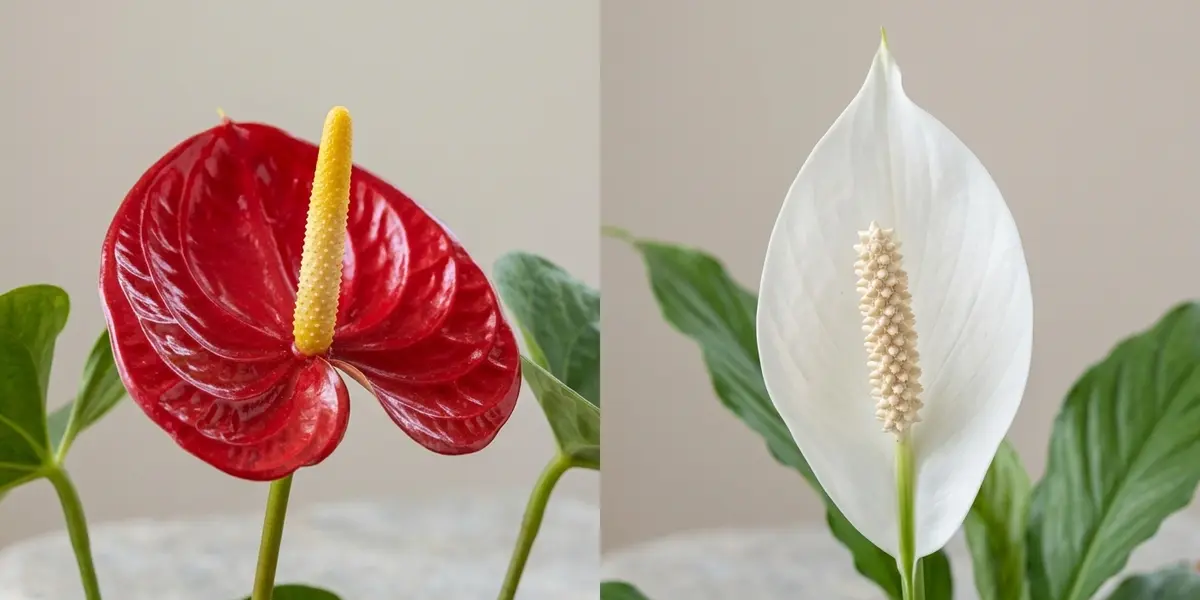
If you already own the plant, you don’t need a botanical degree to identify it. Start with the bloom, then check the leaves and the plant label.
1. Look at the color of the spathe
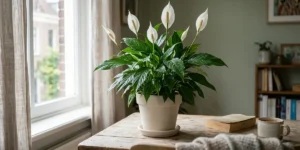
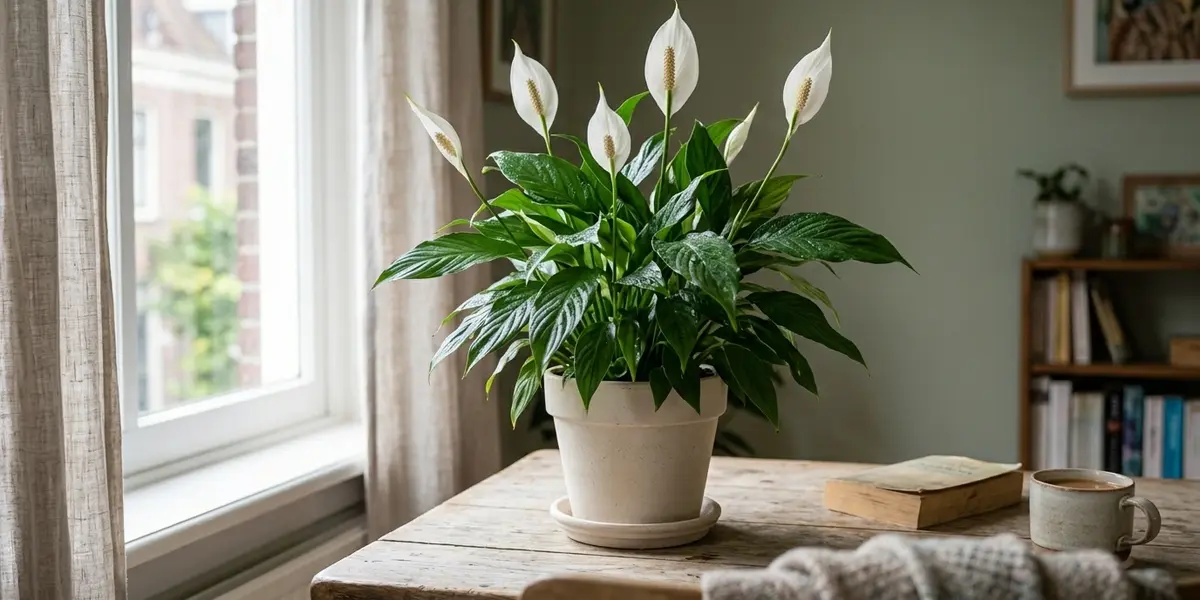
The first clue is often the color. A typical flowering peace lily has a white spathe around its central spadix. As the bloom ages, that white area may turn green or brown.
Anthuriums are commonly sold with red, pink, coral, or white spathes. If your plant has a bright, glossy red bloom, anthurium is the likely identification.
Color alone isn’t perfect because anthuriums can also have white spathes, and peace lily blooms can become greenish. Look at the other features as well.
2. Touch the bloom gently
Anthurium spathes often have a thick, waxy surface that looks almost polished. Their color can remain attractive for a long time.
Peace lily spathes usually look thinner and softer, more like a delicate leaf surrounding the central spike. Don’t squeeze or bend the bloom to test it. A visual comparison is enough, and handling can damage the flower.
3. Examine the leaves
Anthurium leaves are often glossy and heart-shaped, although leaf shape varies among species and cultivars.
Peace lily leaves tend to be longer and narrower, with pointed ends and clear veins running along the blade. Their surface can also be shiny, so glossiness by itself isn’t a reliable identification test.
Look at the whole plant rather than judging one leaf.
4. Check the central spike
Both plants have a spadix, but the surrounding spathe helps distinguish them. An anthurium commonly has a thick, waxy spathe with a noticeable central spike. In many common flowering varieties, the spadix is yellow, cream, or another contrasting color.
A peace lily generally has a narrower, pale spadix surrounded by its white spathe. The shape of the spadix varies, so use this clue alongside bloom texture and leaf shape.
5. Read the botanical name on the label
This is the strongest clue when the label is accurate.
Look for:
- Anthurium – an anthurium.
- Spathiphyllum – a peace lily.
A label that only says “red peace lily” isn’t enough to confirm the botanical identity. Ask the seller for the plant’s scientific name if you need certainty, particularly if you’re choosing a plant for a household with pets.
If you can, photograph the entire plant, its leaves, and the bloom. Those three views are much more useful for identification than a close-up of the red flower alone.
Why Do People Call Anthurium a Red Peace Lily?
Plant names don’t always follow botanical rules. Garden centers, online stores, and plant sellers often use familiar names because shoppers recognize them more easily than scientific names.
A red anthurium and a white peace lily share several visible features. Both have green foliage, a central flower spike, and a surrounding spathe. To someone unfamiliar with houseplants, a red anthurium can look like a colorful version of a peace lily.
The name may also be used to describe the plant’s appearance rather than its actual identity. That can help a shopper recognize a general type of plant, but it becomes confusing when the care instructions are copied from a different species.
True lilies belong to the genus Lilium, which is botanically separate from both Anthurium and Spathiphyllum. Similarly, a calla lily vs. peace lily comparison can help you understand why plants with similar common names may belong to entirely different botanical groups.
This distinction matters for identification and pet safety. True lilies can cause life-threatening kidney injury in cats, while peace lilies and anthuriums cause irritation primarily associated with insoluble calcium oxalate crystals. Don’t assume that all plants with “lily” in their common name have the same effects.
Red Peace Lily vs Anthurium: Care Differences
If your plant has a red, waxy spathe, start with anthurium care rather than copying a peace lily’s routine. The biggest differences are the growing medium, light, and how carefully you manage moisture around the roots.
Give it bright, indirect light
Anthuriums generally flower best in a bright room where the leaves receive plenty of filtered daylight. A position near an east-facing window can work well. A bright south- or west-facing window may also be suitable if a sheer curtain softens strong sun.
Too little light can slow growth and reduce flowering. Direct, intense sunlight can scorch leaves and damage the spathes.
If the plant came from a brightly lit greenhouse or garden center, introduce it to your home gradually. Don’t place it straight into harsh afternoon sun.
Use a chunky, airy potting mix
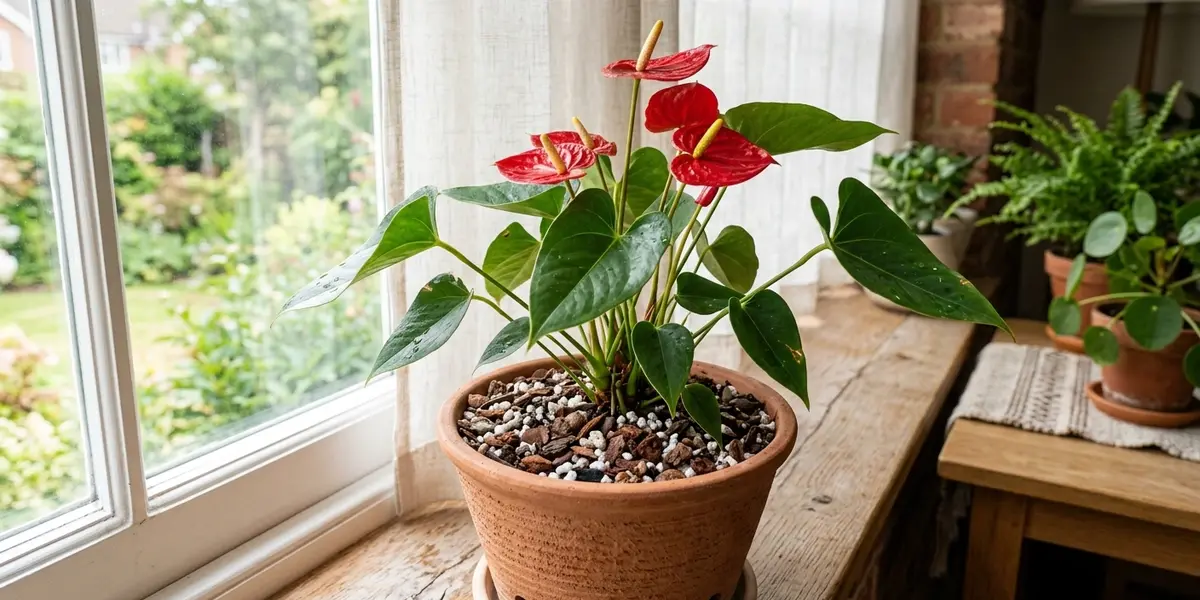
This is one of the most important differences between anthurium care and peace lily care.
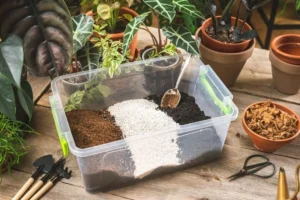
Many commonly sold flowering anthuriums benefit from an open, well-aerated mix that lets water drain while allowing air to reach the roots. A suitable mix may contain orchid bark, perlite, and a moisture-retentive base.
A simple starting blend for a typical flowering anthurium is:
- 2 parts fine orchid bark.
- 1 part perlite or pumice.
- 1 part quality indoor potting mix or coco-based material.
Treat this as a starting recipe, not a universal formula. The right proportions depend on the material’s particle size, your room’s humidity, and how quickly the pot dries. The mix should retain some moisture without becoming compact and soggy.
A dense, water-retentive mix can remain wet for too long around anthurium roots. On the other hand, an extremely coarse mix may dry too quickly in a hot, dry room.
For a peace lily, a standard indoor potting mix that retains some moisture while draining well is usually a better starting point.
When should you water an anthurium?
Don’t water it simply because a week has passed.
Check the potting mix with your finger. For many common flowering anthuriums, allowing the upper inch or two to begin drying before watering is a useful starting point. The exact depth depends on the pot and growing medium.
When watering, moisten the mix evenly and let excess water drain through the bottom. Empty the saucer or outer pot afterward.
Avoid leaving the roots in standing water. Anthuriums need moisture, but their roots also need air.
If your mix is very chunky, the surface may dry before the deeper layers. Check below the surface rather than judging by appearance alone.
Maintain warmth and suitable humidity
Anthuriums are tropical plants and generally prefer warm indoor conditions. The Royal Horticultural Society gives a broad preferred temperature range of about 60–85°F (16–30°C) for anthuriums and recommends bright indirect light, humidity, and open, fast-draining compost.
Avoid cold windowsills, chilly drafts, and sudden temperature changes. Keep the plant away from heating or air-conditioning vents that dry the leaves.
Moderate to high humidity can support healthy growth, particularly when your home air is dry. A humidifier is more consistent than occasional misting if the plant needs additional humidity.
Feed lightly during active growth
Use a balanced houseplant fertilizer according to its label, and avoid heavy doses. Anthuriums don’t need a strong fertilizer solution to produce colorful spathes.
If you use a concentrated liquid product, start conservatively and watch for signs of salt buildup, such as a crust on the mix or repeated brown leaf tips.
Reduce feeding when growth slows. If the plant is struggling with wet soil or damaged roots, correct those problems before adding fertilizer.
Does an anthurium need a rest period?
Growth can slow during darker or cooler parts of the year. When that happens, the plant may use less water and need less fertilizer. This isn’t a reason to force the plant into a cold or dry dormancy. Maintain suitable warmth and light, reduce watering only as the mix dries more slowly, and resume more regular feeding when active growth returns.
Peace Lily Care in Brief
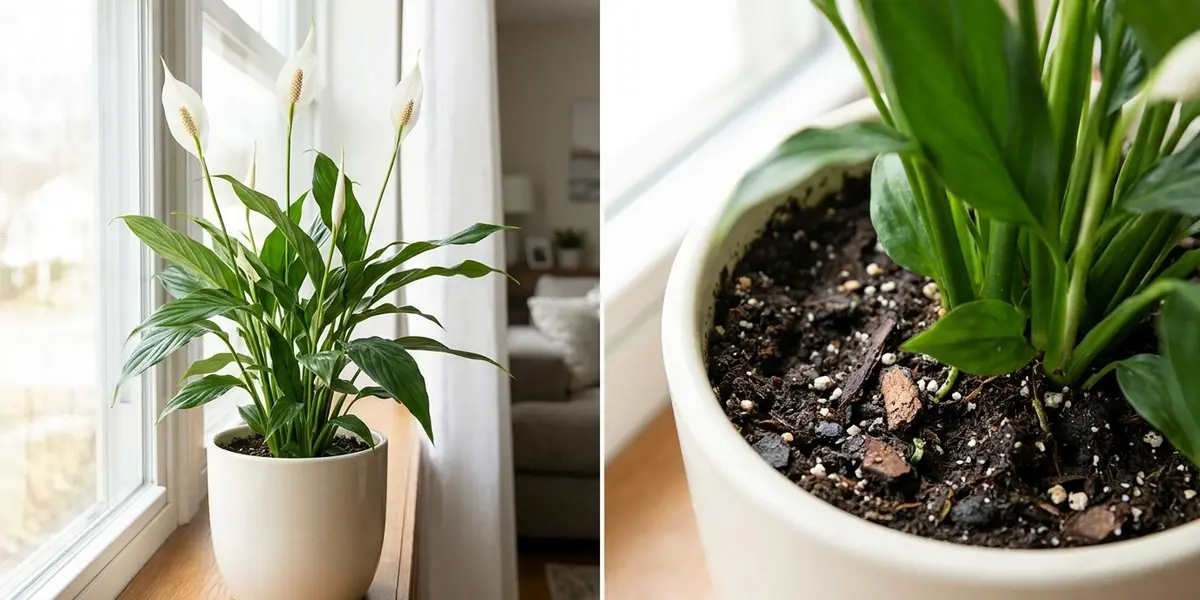
If your plant has long green leaves and soft white spathes, the usual peace lily routine is more appropriate.
- Place it in bright, indirect light, although it can tolerate lower light.
- Water when the top inch of soil feels dry, then let excess water drain.
- Use a moisture-retentive but well-draining houseplant mix.
Peace lilies are generally more forgiving of lower light than flowering anthuriums. For detailed instructions on watering, humidity, repotting, and flowering, read our full Peace Lily Care guide.
Which Is Easier to Grow: Peace Lily or Anthurium?
For most beginners, the peace lily is usually the more forgiving choice. It tolerates lower light, and its leaves often droop noticeably when it needs water. That visible signal can help a new plant owner learn its routine.
Anthuriums can be easy to grow once their needs are understood, but their roots are less suited to dense, persistently wet soil. Checking the mix and keeping it airy is especially important.
Neither plant is completely carefree. A peace lily can still suffer from root rot, and an anthurium can thrive for years in a suitable home.
| Your situation | Better starting choice | Why |
| Your room has lower light | Peace lily | More tolerant of lower light, though flowering may decrease |
| You want red or pink blooms | Anthurium | Common flowering varieties offer colorful, waxy spathes |
| You often forget to check soil | Neither is ideal | Both need moisture checks; anthurium roots especially need good aeration |
| You are learning basic houseplant care | Peace lily | Usually more adaptable to ordinary indoor conditions |
| You enjoy mixing bark and airy growing media | Anthurium | Many flowering types benefit from a chunky mix |
| You have cats or dogs that chew plants | Neither within reach | Both are toxic if chewed |
The best choice isn’t necessarily the plant with the fewest care instructions. It’s the one whose needs fit your room and the attention you’re realistically able to give it.
Which Blooms Longer: Anthurium or Peace Lily?
If long-lasting color is your priority, anthuriums often have the advantage.
An individual anthurium spathe can remain attractive for two to three months under suitable conditions. A peace lily spathe commonly lasts several weeks before fading or turning green. Actual bloom life varies with the cultivar, light, temperature, and the plant’s condition.
The long-lasting, waxy spathe is one reason flowering anthuriums are popular as indoor gifts. Their blooms can hold their color for much longer than many delicate houseplant flowers.
Peace lilies have a different appeal. Their white spathes create a softer look, and a healthy mature plant may produce multiple blooms over time.
How can you encourage more blooms?
For anthuriums, provide enough bright indirect light, maintain warm conditions, and avoid keeping the roots soggy. Don’t increase fertilizer simply because the plant isn’t flowering.
For peace lilies, improve indirect light if the plant is growing in a dim corner. Also check whether root crowding, poor drainage, or other stress is slowing growth.
Neither plant can be guaranteed to flower continuously in every home. A plant may grow healthy leaves for a period without producing a new bloom, particularly when light levels are low.
Are Anthurium and Peace Lily Toxic to Cats and Dogs?
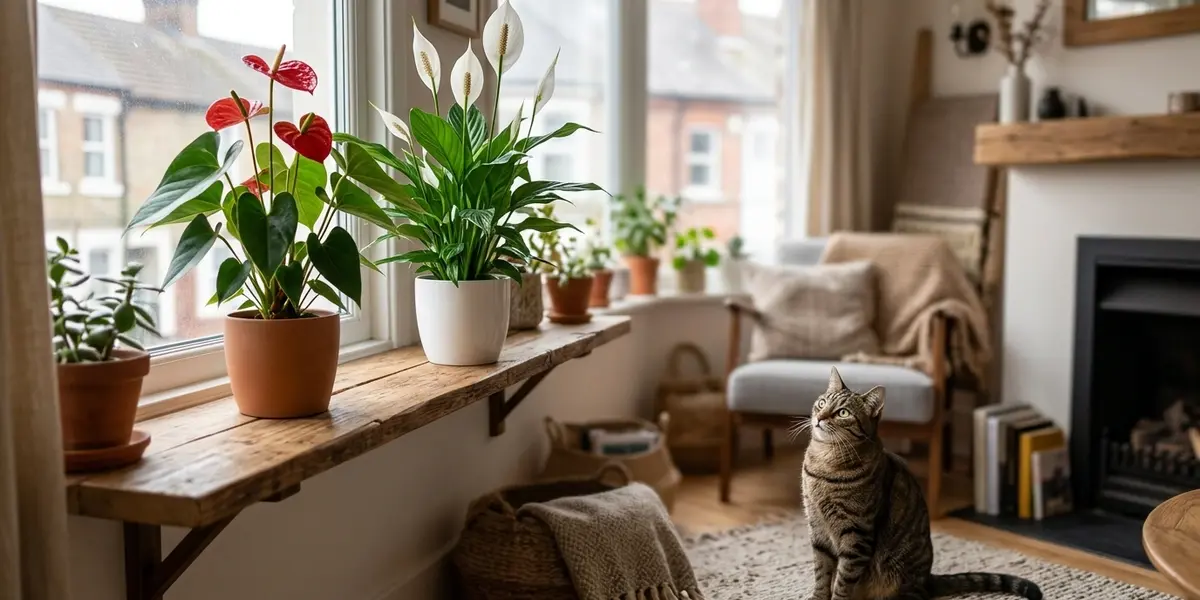
Yes. Both are toxic to cats and dogs if chewed.
The ASPCA lists peace lilies (Spathiphyllum) and anthuriums among plants that contain insoluble calcium oxalate crystals. These crystals can cause intense irritation in the mouth and throat. Signs may include drooling, pawing at the mouth, vomiting, and difficulty swallowing.
If your pet chews either plant, contact your veterinarian promptly for advice. If your pet has trouble breathing or swallowing, seek urgent veterinary care.
The ASPCA Animal Poison Control Center can also provide guidance at (888) 426-4435; consultation fees may apply. Its official Peace Lily toxicity page and Anthurium-related plant listing are useful references.
If you have pets that like to chew leaves, place these plants where they cannot reach them or choose a verified pet-safer alternative.
Common Problems: Drooping, Brown Tips and Pests
The two plants can develop similar-looking symptoms for different reasons. Before changing the watering routine, check the soil, drainage, light, and the plant’s recent environment.
| Problem | Anthurium: possible cause and first fix | Peace lily: possible cause and first fix |
| Drooping leaves | Dry mix or damaged roots; check below the surface before watering | Dry soil may cause drooping; check for wet soil before adding water |
| Yellow leaves | Overwatering, poor drainage, or other stress; inspect the mix and roots | Overwatering, low light, aging leaves, or root issues; check the soil first |
| Brown tips or edges | Dry air, fertilizer salts, water quality, or watering stress | Dry air, mineral buildup, fertilizer, or inconsistent moisture |
| No blooms | Insufficient light, unsuitable conditions, or plant maturity | Low light, a young plant, or general growing stress |
| Spider mites | Look for fine webbing and tiny speckled marks; inspect leaf undersides | Spider mites can also occur; inspect leaves and stems |
| Root problems | Dense, wet soil can reduce oxygen around roots | Constantly wet soil and poor drainage can damage roots |
What if an anthurium’s leaves turn yellow?
Start with the roots and growing mix. If the potting medium remains wet for a long time, check whether it has become compacted or whether the container drains properly.
If the roots are healthy and the mix is drying normally, review light, temperature, and recent fertilizer use. Avoid repotting repeatedly without a clear reason.
What if a peace lily droops?
A peace lily often droops when its soil becomes too dry, but drooping isn’t proof that it needs water. If the soil is wet, investigate drainage and root health instead.
How do you check for spider mites?
Spider mites can leave tiny pale speckles on leaves and may produce fine webbing, especially underneath the foliage. Inspect the undersides of leaves and around the stems.
If you find mites, isolate the plant from nearby houseplants. Rinse the leaves where practical and use a product labeled for the pest and plant, following its instructions. Avoid spraying in strong direct sunlight or applying treatments not intended for houseplants.
Which One Should You Buy?
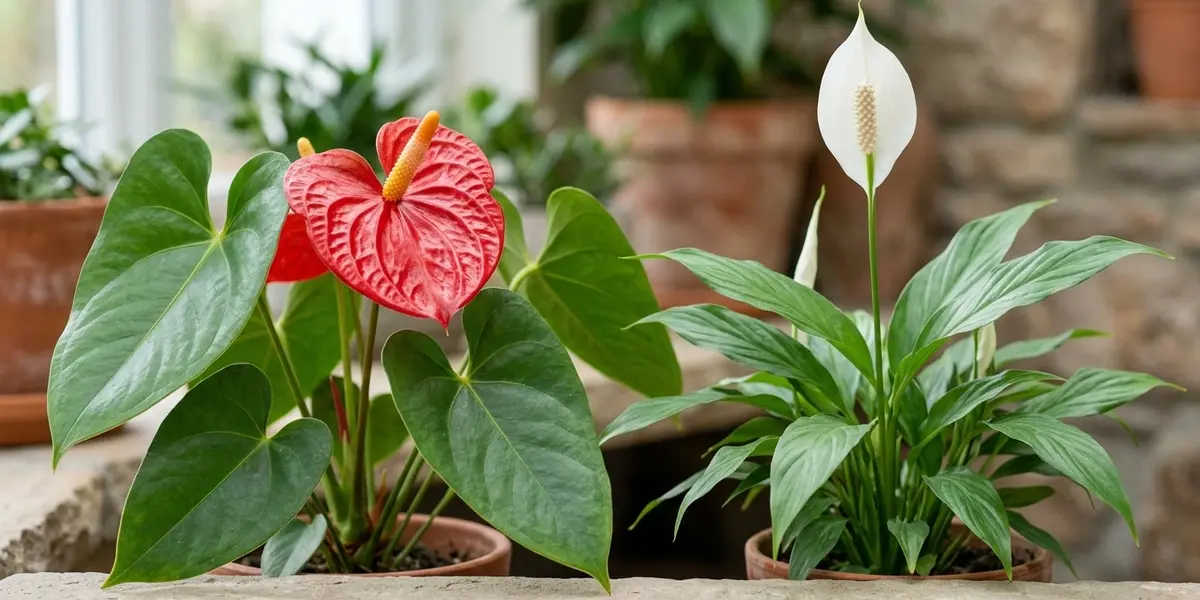
Choosing between an anthurium and a peace lily becomes easier when you think about your room, your routine, and the look you want.
Answer these four questions before buying.
1. How much natural light does your room receive?
If the room is relatively dim, a peace lily is often the more practical choice because it tolerates low light conditions, although it may produce fewer flowers.
If you have a bright window with filtered light, either plant may work well.
2. Do you want colorful or white blooms?
Choose an anthurium if you prefer red, pink, or other colorful spathes that can last for months. Choose a peace lily if you like white, elegant blooms and long green leaves.
3. Are you likely to forget about watering?
Neither plant should be left without checks for long periods. A peace lily’s drooping leaves may give you a visible warning when it is thirsty, but waiting for severe drooping isn’t a good routine.
Anthuriums benefit from regular soil checks because the mix must balance moisture and air. If you tend to water every plant on the same schedule, either plant may struggle.
4. Do you have pets?
If cats or dogs can chew your houseplants, don’t leave either plant within reach. Both contain insoluble calcium oxalate crystals and can irritate the mouth and digestive tract.
Your plant should fit your household, not just your decorating style.
Switch Your Care in 15 Minutes: If You Bought a “Red Peace Lily”
If you’ve discovered that your red peace lily is actually an anthurium, don’t panic and immediately strip away all its soil. First identify the plant, check its current condition, and make only the changes it needs.
Minute 1–3: Confirm the plant
Look at the bloom, leaves, and label. A glossy red spathe and an Anthurium label are strong clues.
If the label is unclear, photograph the whole plant and compare it with reliable botanical or grower references.
Minute 4–6: Check the soil and drainage
Touch the mix below the surface. Is it still wet several days after watering? Does the pot have drainage holes? Is the soil dense and compacted?
These checks help you decide whether the plant needs repotting now or can remain in its current pot.
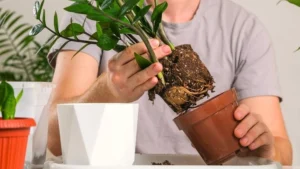
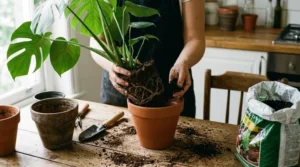
Minute 7–10: Decide whether to repot
If the mix is airy, the pot drains properly, and the roots appear healthy, there’s no need to repot just because the label was wrong.
If the soil is dense and stays soggy, or the roots show signs of damage, repotting may be appropriate. Use a clean pot with drainage holes and an open mix suitable for anthuriums.
Don’t choose a much larger pot. A container that holds excessive wet mix around a small root system can create new problems.
Minute 11–13: Choose a better spot
Move the plant to bright, indirect light. Avoid direct afternoon sun and cold drafts.
If the plant has been in a dim room, increase light gradually rather than exposing it to strong sunlight immediately.
Minute 14–15: Set a new watering routine
Don’t set an automatic weekly watering day. Instead, check the mix and water when its upper layer has begun to dry, taking the mix’s texture into account.
After watering, allow excess water to drain and empty the saucer.
The most important change isn’t a new pot or an expensive fertilizer. It’s understanding that anthurium roots need both moisture and air.
Conclusion: The Right Name Leads to Better Care
Imagine returning to the garden center with a clearer idea of what you bought. The red bloom that was labeled “red peace lily” is now easier to identify: its waxy spathe and glossy leaves point toward an anthurium.
That small discovery changes the care routine. Instead of treating the plant exactly like a peace lily, you give it bright indirect light, an airy growing mix, and careful watering that allows the roots to breathe.
You don’t need to replace a healthy plant just because the shop used a confusing name. Check its condition first, make any needed changes gradually, and give it time to adjust.
If you prefer white blooms and a plant that tolerates lower light, a peace lily may suit you better. If you love lasting red or pink color and can provide the right conditions, an anthurium is a good option.
The lesson is simple: identify the plant before you follow its care instructions. A little clarity at the beginning can save you money, time, and a struggling houseplant.
Frequently Asked Questions
1. Is there a red peace lily?
The term is commonly used by some sellers for a red anthurium. Familiar peace lilies (Spathiphyllum) have white spathes that may turn green as they age, while common flowering anthuriums offer red, pink, and other colors.
2. Is an anthurium a peace lily?
No. They are different genera in the same Araceae family. Anthuriums are Anthurium species, while peace lilies are Spathiphyllum species.
3. Can you grow an anthurium in low light?
Anthuriums may survive in lower light, but growth and flowering can suffer. Bright, indirect light is generally better for a flowering plant.
4. Do anthuriums bloom all year?
Anthuriums can flower repeatedly under suitable conditions, but continuous blooms aren’t guaranteed. Light, temperature, plant maturity, and cultivar all affect flowering.
5. Is an anthurium poisonous to cats and dogs?
Yes. Anthuriums contain insoluble calcium oxalate crystals that can irritate a pet’s mouth and digestive tract. Keep them out of reach and contact a veterinarian if your pet chews the plant.
6. How often should I water an anthurium?
Check the mix rather than following a fixed schedule. For many flowering varieties, water when the upper inch or two has begun to dry, then let excess water drain.
7. Why are my anthurium leaves turning yellow?
Overwatering, poor drainage, insufficient light, and other stress can cause yellow leaves. Check the mix and roots before changing the plant’s care routine.
8. Can I put a peace lily and an anthurium together?
You can display them in the same room if their light and temperature needs suit the location. Keep each plant in its own pot so you can manage its different soil and watering needs.
9. What is the difference between a peace lily and a calla lily?
Peace lilies are Spathiphyllum, while calla lilies are Zantedeschia. They are different plants, despite the shared common name “lily,” and their care and toxicity details should be checked separately.
10. Why did my red peace lily lose its color?
If it is an anthurium, fading can occur as a spathe ages. Light, growing conditions, and cultivar can also affect its appearance. Check the newest blooms before assuming the whole plant is unhealthy.