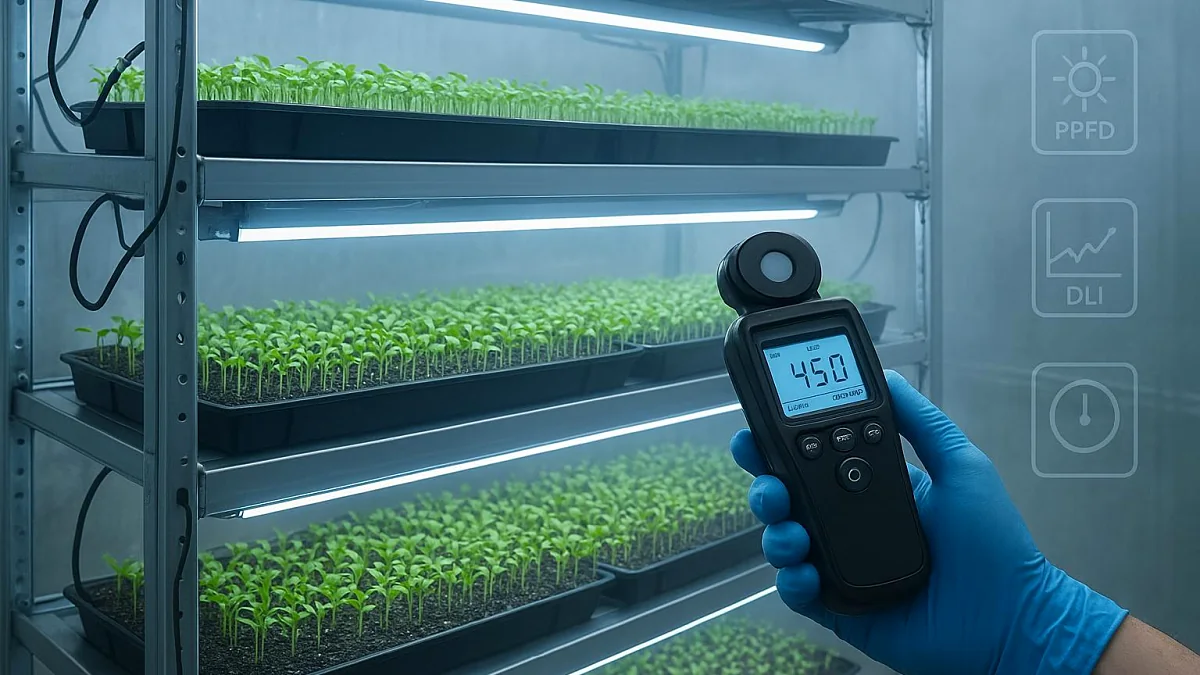
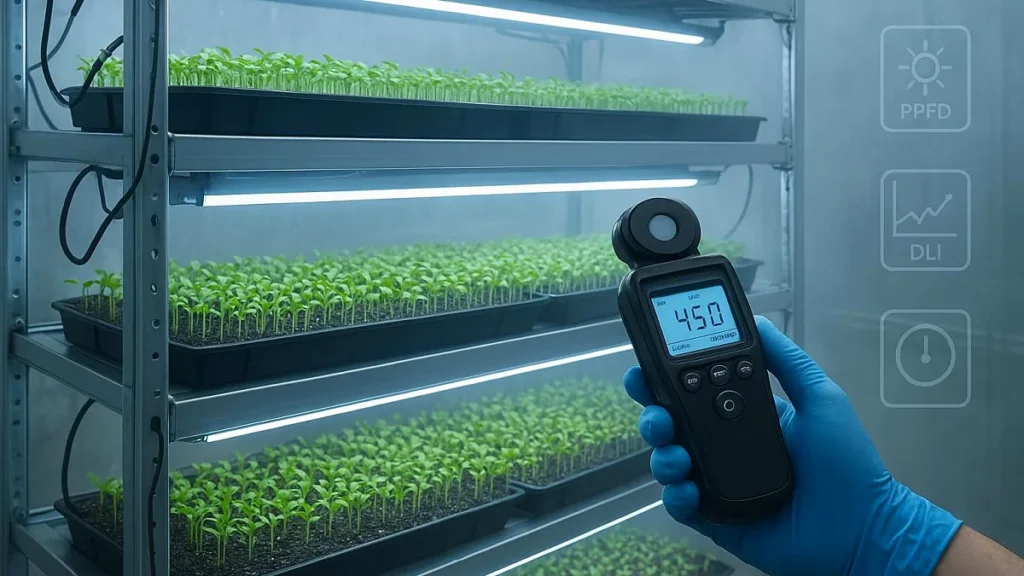
A basic Plant Light meter can help you compare bright and dim spots for houseplants, but a PPFD meter is the better choice for measuring light from grow lights. Lux measures brightness as people see it; PPFD measures the plant-usable light reaching a surface. If you only need occasional readings, a smartphone app may be enough.
The right tool depends on what you grow and how precise your measurements need to be. Before spending money, it helps to understand what each reading actually tells you.
Why Plants Don’t Care About Lux
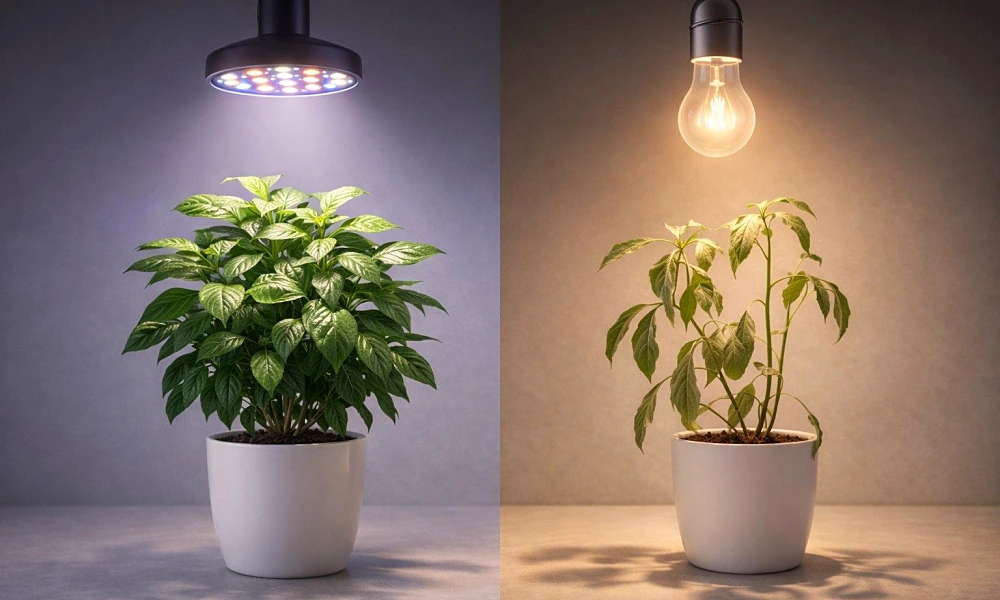
Lux measures how bright light appears to the human eye. It gives more weight to some colors than others, so it does not tell you exactly how much light a plant can use for photosynthesis.
Plants use a range of light wavelengths called photosynthetically active radiation (PAR). This is generally defined as light between 400 and 700 nanometers.
PPFD stands for photosynthetic photon flux density. It measures how many PAR photons reach a square meter of surface each second. The unit is micromoles per square meter per second (µmol/m²/s).
Here is the practical difference:
- Lux: How bright the light looks to people.
- PAR: The range of light used in photosynthesis.
- PPFD: How much PAR light reaches a particular surface.
- DLI: The total amount of PAR a plant receives over a full day.
This distinction matters when you compare different grow lights. Two lamps can show similar lux readings but deliver different amounts of plant-usable light because their light spectra differ. A lux meter is useful for comparing general brightness, but it cannot reliably replace a PPFD meter for evaluating grow-light performance.
Iowa State University Extension explains the difference between lux, foot-candles, PPF, and PPFD in its guide to supplemental plant lighting.
The Three Types of Plant Light Meters
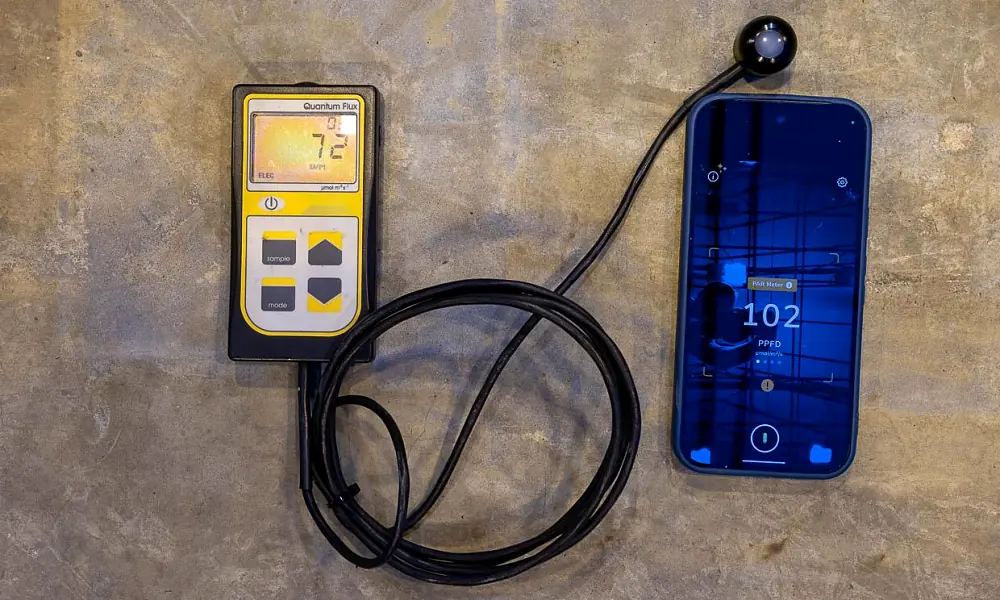
You will usually come across three options. Each has a different purpose and price level.
1. Basic Lux Meters
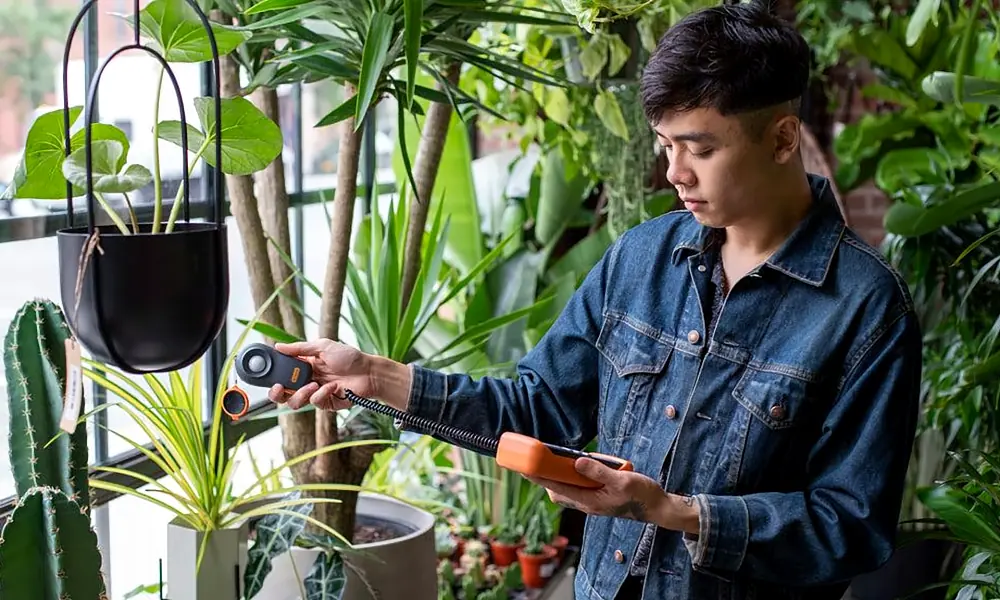
A handheld lux meter measures the brightness of a light source or location. It is a practical choice if you mainly want to compare places around your home.
For example, you can use one to check whether a plant receives more light near a window than it does on a shelf across the room.
A basic lux meter is useful for:
- Comparing window locations.
- Checking whether a corner is brighter or darker.
- Monitoring changes after moving a plant.
- Getting consistent readings from the same type of light.
Its main limitation is that it does not directly measure the photons plants use for photosynthesis. It is therefore not the best tool for comparing different grow-light technologies.
2. PAR and PPFD Quantum Meters
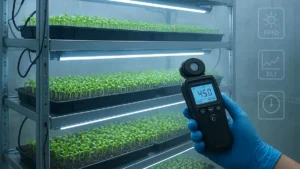
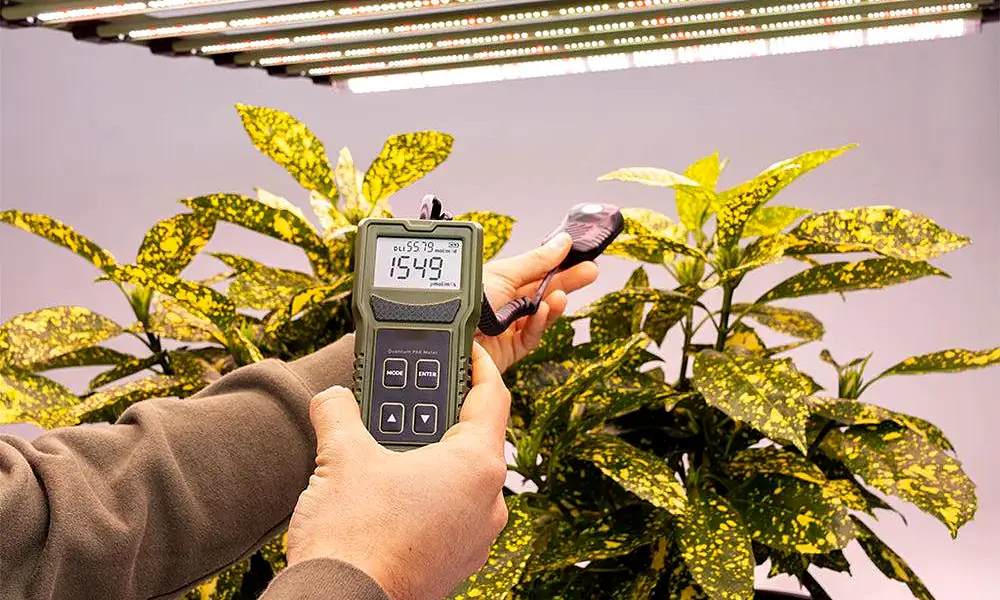
A quantum meter measures plant-usable light and reports PPFD. This is the more suitable option if you grow plants under artificial lighting and want to check how much light reaches their leaves.
These meters are especially useful for:
- Setting the height of grow lights.
- Comparing light intensity across a growing shelf.
- Checking whether plants receive even coverage.
- Monitoring light levels for seedlings, herbs, and other plants grown indoors.
Professional meters can be expensive, so they may be unnecessary if you only keep a few houseplants near windows.
3. Smartphone Light Meter Apps
Some smartphone apps estimate lux or PPFD using the phone’s light sensor or camera. They are convenient because you can take readings without buying a separate handheld device.
However, app accuracy depends on the phone, sensor, calibration, light-source setting, and accessories. Some camera-based apps also require a diffuser to help light reach the camera evenly.
For a general comparison of indoor locations, an app may be enough. If you are adjusting a serious grow-light setup, use a dedicated meter or compare the app against a reliable reference instrument.
Best Plant Light Meters by Use Case
There is no single best meter for every indoor gardener. The most sensible choice depends on how you use it.
Best Professional Option: HOPOOCOLOR OHSP350P
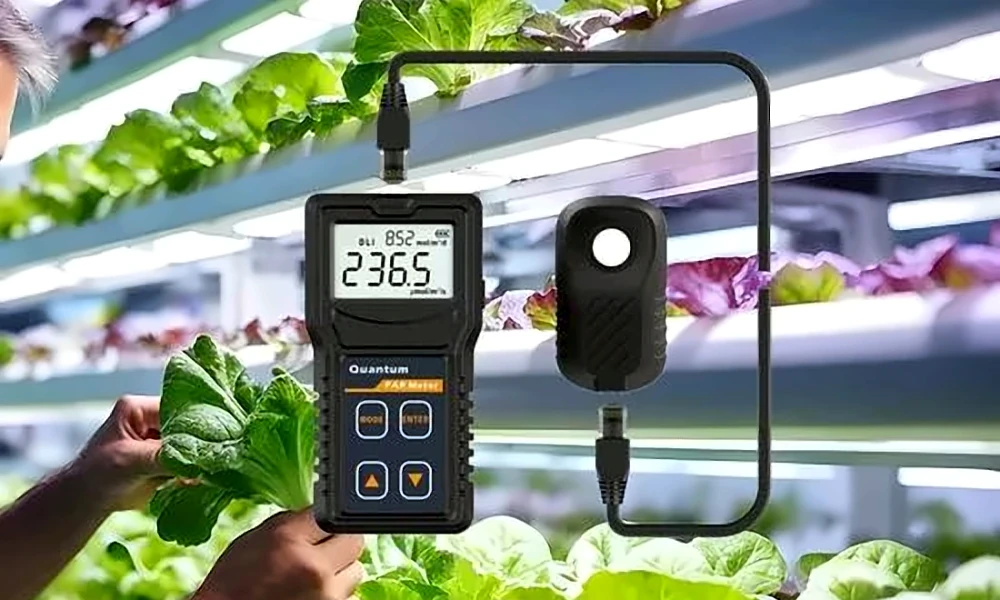
The HOPOOCOLOR OHSP350P is a plant-lighting analyzer that measures PPFD, PAR, lux, and foot-candles. Its manufacturer also lists spectral measurement features, a touchscreen, and a rechargeable battery.
It is worth considering if you need more than a simple brightness reading and want to examine different properties of a light source.
What to consider before buying:
- It is a specialist instrument rather than a basic household meter.
- Its range of features may be unnecessary for someone with a few plants.
- Check the current price, package contents, calibration information, and seller support before ordering.
You can review the manufacturer’s OHSP350P specifications before deciding. These are manufacturer-listed specifications, not independent test results.
Best Budget Option: Photone App
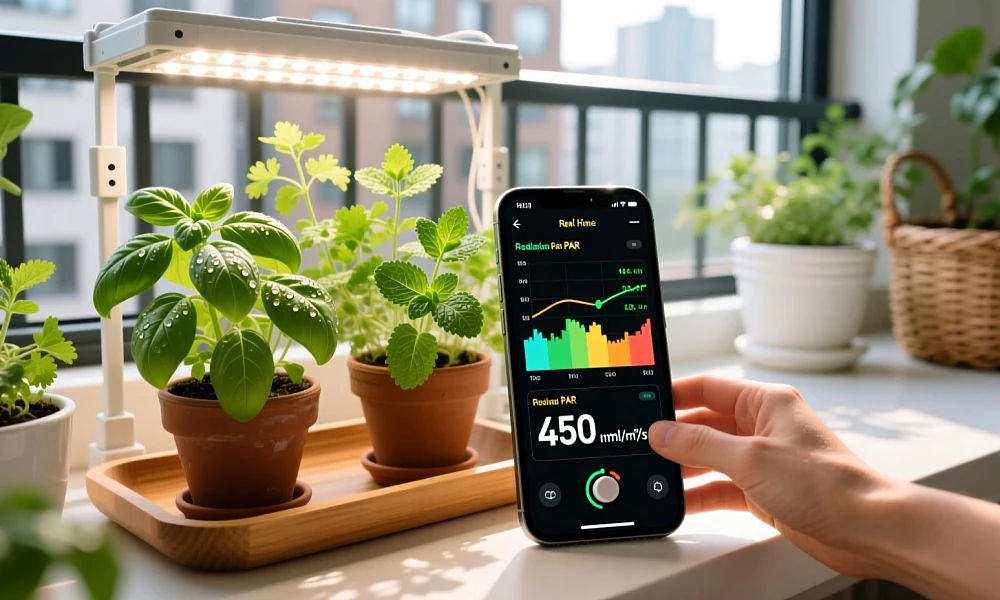
Photone is a smartphone app designed to measure plant lighting. It offers readings for PPFD, DLI, lux, and foot-candles, depending on the phone and available features.
It can be a useful starting point if you want to compare light levels without purchasing a dedicated meter. However, check your device’s compatibility first.
There are two details worth knowing:
- A diffuser may be required: Photone explains that camera-based measurements need a diffuser to spread light evenly across the camera sensor.
- Not every phone measures in the same way: Some supported devices use camera-based measurements, while others may fall back to a built-in ambient light sensor. The app says this fallback is less accurate.
Photone publishes its own comparison tests against professional meters. Those tests are useful to review, but they come from the app’s developer, so they should not be treated as independent proof of accuracy.
Best Simple Option: A Handheld Lux Meter
If you only want to compare natural-light locations, a basic digital lux meter is usually the most practical purchase.
You do not need a professional spectrometer just to find out whether a windowsill is brighter than a nearby table. Choose a meter with a clear display, a suitable sensor, and consistent customer feedback.
Remember that its readings are best used for comparing locations under similar lighting conditions, not for judging the performance of different grow-light spectra.
How to Measure Light for Plants Properly
Even a good meter can give you misleading information if you use it incorrectly. A few simple habits will make your readings more useful.
Measure at Leaf Level
Place the sensor where the plant’s leaves actually receive light. Measuring beside the lamp or at the top of a shelf will not tell you what reaches the foliage.
This matters because light intensity changes with distance. A reading taken close to a grow light can be much higher than one taken at the plant’s canopy.
Take Readings in Several Places
Do not rely on one measurement. Check several points across the plant or growing area.
For example, the leaves directly beneath a lamp may receive much more light than leaves near the edges. Taking multiple readings helps you spot uneven coverage.
Use the Correct Light-Source Setting
If your meter or app asks you to select a light source, choose the closest available option, such as full-spectrum LED or fluorescent.
Different light sources have different spectra. Using the wrong setting can affect the estimated PPFD reading.
Consider Light Duration, Not Just Intensity
A plant’s daily light supply depends on both the intensity of the light and how long it receives it.
This is where Daily Light Integral (DLI) becomes useful. DLI measures the total amount of photosynthetically active light received over a 24-hour period.
For example, a plant receiving moderate light for a longer period may receive a similar daily total to one receiving stronger light for fewer hours. The two situations are not automatically interchangeable, because plant species and their preferred light cycles still matter.
If you want to explore artificial lighting further, see our guides to LED grow lights and growing seedlings.
PPFD Reference Ranges for Indoor Plants
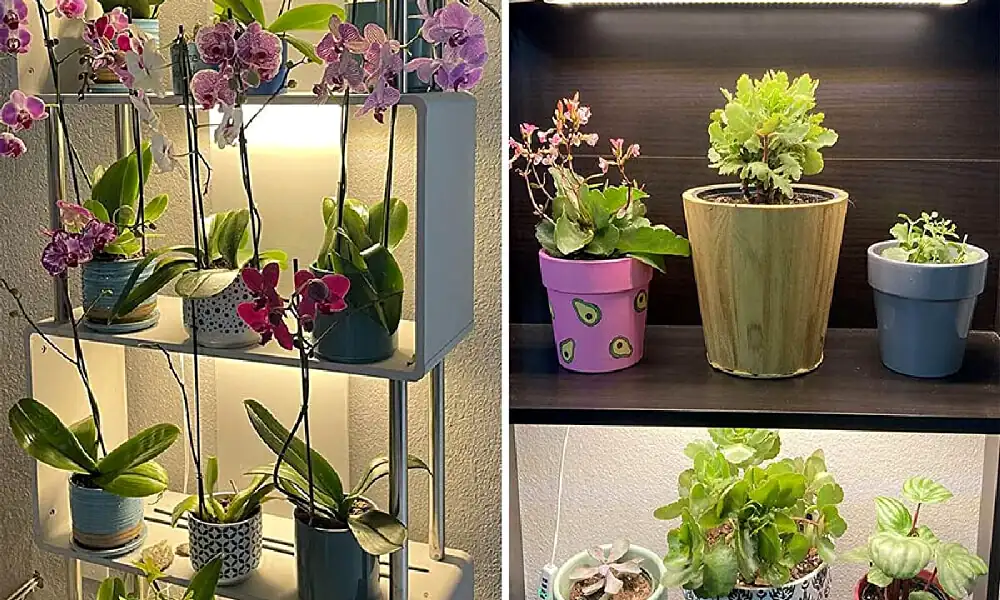
PPFD readings can help you understand how much light reaches a plant, but there is no single target that works for every houseplant.
The following figures are examples published in a University of Maine Cooperative Extension guide. They are useful starting points, not universal instructions for every variety or growing condition.
| Plant or growth stage | Example PPFD range (µmol/m²/s) |
| Seedlings and clones | Below 100 |
| Vegetative growth | 100–500 |
| Flowering and fruiting | 400–1,200 |
| African violets | 50–150 |
| Philodendrons | 50–250 |
| Succulents | 100–200 |
| Herbs | 100–500 |
| Orchids | 40–500 |
Notice that some plant groups have wide ranges. That is because species, growth stage, light duration, and growing conditions all affect what works.
For a specific plant, check its care requirements rather than relying on a general category. For example, our guide to peace lily light explains why this plant’s needs differ from those of sun-loving succulents.
Use a meter to understand the conditions you have, then adjust the plant’s position or lighting gradually. Watch for signs such as weak, stretched growth or leaf damage instead of treating one reading as the whole answer.
FAQ: Plant Light Meters
Do I need a PAR meter for houseplants?
Usually, no. If your plants grow near windows and you only want to compare brighter and darker locations, a basic lux meter or a suitable phone app may be enough. A PPFD meter becomes more useful when you use grow lights or need to measure plant-usable light more precisely.
Are phone light meter apps accurate?
They can be useful, but accuracy varies by phone, sensor, calibration, and app. Some camera-based apps require a diffuser, and some phones use less accurate ambient light sensors instead. Treat app readings as estimates unless you have checked them against a reliable reference meter.
What lux level do houseplants need?
There is no single lux target for all houseplants. Different species have different light requirements, and lux does not account for the spectrum of light. Use lux to compare locations under similar lighting, then check the care requirements of the plant you are growing.
What is the difference between lux and foot-candles?
Both measure light as the human eye perceives it. Lux measures lumens per square meter, while foot-candles measure lumens per square foot. One foot-candle is approximately 10.76 lux. Neither unit directly measures the plant-usable light reported by a PPFD meter.
Is a PPFD meter better than a lux meter?
For measuring grow-light intensity, yes. PPFD tells you how much photosynthetically active light reaches a surface. A lux meter is still useful for comparing general brightness in rooms and near windows, but it is less suitable for evaluating different grow-light spectra.
Final Thoughts About Plant Light Meters
The best plant light meter is the one that answers the question you actually have. For comparing window locations, a simple lux meter is often enough. For grow-light setups, a PPFD meter gives you more relevant information. A phone app can be a convenient middle ground, provided you understand its limits and use the correct setup.
You do not need expensive equipment just to keep ordinary houseplants healthy. Start by understanding the light your plants receive, measure at leaf level when needed, and use plant-specific care guidance to make sensible adjustments.
Disclaimer: Light meter readings are estimates and can vary depending on the device, sensor, and light source. Use them as a guide, and consider your plant’s specific lighting needs before making changes.