A bird of paradise is the plant you buy for the flowers and keep for the leaves. Those tall, paddle-shaped leaves fan out like a hand of cards and turn an ordinary corner tropical, long before a single bloom appears. That is just as well, because indoors this plant is famously slow to flower. Most owners wait years — and still would not give the plant up.
This guide is about the classic orange bird of paradise, Strelitzia reginae, the one with the crane-shaped orange and blue flowers. It is the smaller cousin of the white bird of paradise, which grows much taller and flowers white, so if your plant is already brushing the ceiling, you may be growing the other one.

Light: Give It the Brightest Spot You Have
Light is the one thing a bird of paradise will not compromise on. Indoors it wants the brightest window in the house — a south-facing window is ideal, or a west-facing one with several hours of direct sun. In a dim corner it stops growing, new leaves come out smaller, and flowering becomes almost impossible.
Harsh midday sun in summer is usually fine for a mature plant that has been acclimatised gradually. A plant moved suddenly from a shaded shop shelf into blazing sun can scorch, so give it a week or two of bright indirect light first. In winter, push the pot as close to the window as you can without leaves touching cold glass.
Rotate the pot a quarter turn every couple of weeks. The leaves all lean toward the light, and without rotation the plant ends up lopsided, with one side full and the other bare. If you want more ideas for filling a sunny spot, our guide to indoor plants with big leaves shows which bold-leafed plants share a bird of paradise’s taste for bright rooms.
Watering: Deep Drinks, Then Let It Dry
Watering a bird of paradise is a rhythm, not a schedule. In spring and summer, water thoroughly until it runs out of the drainage holes, then wait until the top two inches of soil feel dry before watering again. Roughly once a week in summer, once every two weeks in winter — but the finger test beats the calendar.
The two mistakes are opposites. Too little water and the leaves curl inward along their edges. Too much water is worse: soggy soil rots the thick, fleshy roots, and the first symptom is yellowing lower leaves that feel soft at the base. Always empty the saucer after watering, and never let the pot sit in standing water.
Use a pot with generous drainage holes and a loose, chunky mix — ordinary potting soil with perlite or orchid bark stirred in. Repot only when the roots are clearly crowded, usually every two to three years in spring, moving up just one pot size.

Humidity and Temperature: Warm Air, No Draughts
Between 65°F and 85°F is ideal, and it should never sit below 50°F for long. Keep it away from cold draughts in winter, and just as far from radiators and hot-air vents, which dry the air and crisp the leaf edges.
Average household humidity of 40 to 50 percent is enough for this plant. If your home is very dry in winter, group it with other plants, set the pot on a tray of pebbles with water, or run a small humidifier nearby. Misting helps for an hour or two at most, so treat it as leaf cleaning rather than a humidity strategy.
That brings us to the chore every bird of paradise owner eventually accepts: leaf cleaning. Those big, smooth leaves collect dust fast, and dusty leaves photosynthesise poorly. Once a month, wipe each leaf top and bottom with a soft, damp cloth, supporting the leaf from underneath so it does not crack.
Why It Rarely Flowers Indoors — and What Helps
A bird of paradise grown indoors may take five to seven years to flower, and many never do. The crane-shaped blooms need a mature plant, a lot of light, and a distinct seasonal rhythm: a warm, bright growing season followed by a cooler, drier rest in winter. A plant kept the same way all year has no reason to bloom.
If flowering is your goal, give the plant the brightest spot you own, let it get slightly pot-bound, and in winter cut back on water and stop feeding while keeping it above 55°F. In spring, resume feeding with a balanced liquid fertiliser every four to six weeks. Even then, flowering is a hope, not a promise. If you love bold tropical blooms generally, our guide to tropical flowers to grow indoors and out covers the species that flower far more readily, including hibiscus and anthurium.

Splitting a Plant That Has Outgrown Its Pot
An established bird of paradise grows as a clump of fans joined at the base, and over time that clump can be divided — the best way to get a second plant, and the best fix for one that has become too wide for its spot.
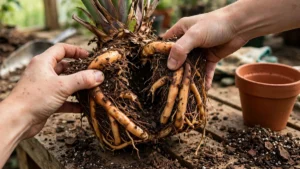
Divide in spring, just as growth resumes. Take the plant out of its pot and clear away enough soil to see where the fans join. Each division needs its own fan of leaves and a healthy section of roots. Pull the clump apart gently by hand where it wants to separate; where it resists, cut cleanly through the root crown with a sharp, sterilised knife. Pot each division in fresh mix, water well, and keep it in bright indirect light for a few weeks while the roots settle. New divisions often sit still for a month or two before pushing out a new leaf, and that is normal.
Do not divide a young plant with only one or two fans. Wait until the clump has at least four or five fans, so each half is strong enough to recover. And do not expect flowers from a fresh division for a few years — splitting resets the flowering clock.
Common Problems and Quick Fixes
Most troubles trace back to light or water. Leaves splitting along their natural seams is normal — in the wild, wind shreds them, and indoors they split as they unfurl. Brown, crispy leaf edges usually mean dry air or salts from tap water; flush the soil with clean water occasionally, or switch to rainwater or filtered water.
Leaves curling inward point to thirst or cold; yellow lower leaves usually mean overwatering. A plant leaning hard toward the window wants more light or a regular rotation. Pests are uncommon, but check leaf bases and undersides for scale and mealybug, wiping off any you find with a soapy cloth.
Be patient with new leaves. They emerge as tight, rolled spears and unfurl slowly, sometimes over weeks. Do not try to help one open — a forced leaf tears. Give this plant bright light, a deep drink when the soil dries, clean leaves, and room to grow, and it will repay you with years of drama. Our guide to tropical foliage plants shows how to pair it with monstera and elephant ear for a jungle corner.