Burro’s tail is one of those plants that stops people mid-sentence. Long ropes of plump, blue-green leaves spill over a hanging basket like a green waterfall, and a mature plant can trail a metre or more. What most people do not realise is that there is not just one burro’s tail. Nurseries sell a whole family of closely related forms — some short and chunky, some powdery blue, some splashed with cream, and one or two that flush pink in strong sun. Here are 12 burro’s tail varieties worth growing, each with a note on what it looks like and who it suits best.
1. Classic Burro’s Tail
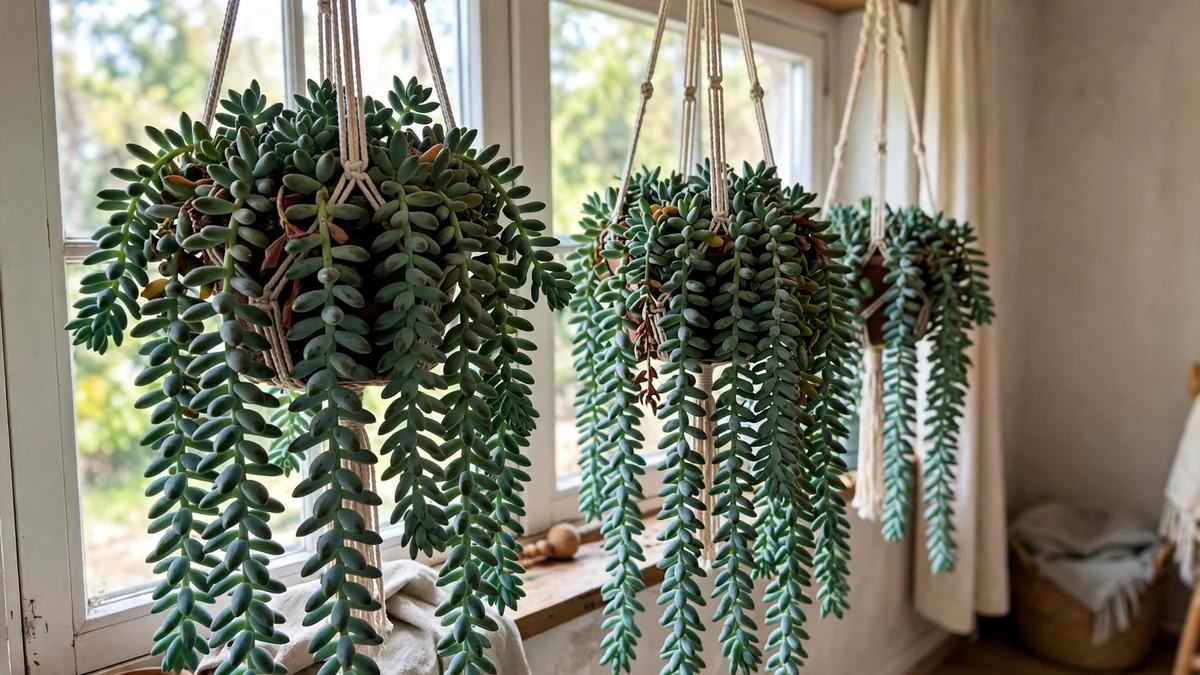
The original, Sedum morganianum, and still the one to beat. Its stems are thick ropes of pointed, blue-green leaves with a soft powdery coating, and they can reach a metre long on a happy old plant. Give it bright light, water sparingly, and hang it somewhere nobody brushes past — the leaves drop at the slightest knock. Best for: anyone who wants the full waterfall effect and has the patience to wait for it.
2. ‘Burrito’, the Baby Burro’s Tail
Sedum burrito looks like the classic plant shrunk down and made friendlier. The leaves are shorter, rounder, and packed tightly along thinner stems, so the whole plant reads as plump and neat rather than long and ropey. It trails to about half a metre and is noticeably less fragile than the classic. Best for: beginners, small spaces, and anyone who has knocked leaves off the classic one too many times.

3. Variegated Burro’s Tail
The variegated form of Sedum morganianum keeps the same long, ropey stems but splashes the leaves with cream and pale yellow. In bright light the pale sections glow almost white, which makes the plant look lighter and airier than the solid green form. It grows more slowly and needs bright indirect light to keep its variegation — in shade it drifts back toward green. Best for: collectors and bright shelves.
4. Variegated ‘Burrito’
Take the compact, round-leaved ‘Burrito’ and add cream variegation, and you get a plant that looks like a string of tiny green and white beads. The stems stay shorter and tidier than the variegated classic, and the contrast is sharper because the leaves are so small. It is slow, a little fussy about light, and usually pricier — but it is the prettiest burro’s tail you can put on a small shelf. Best for: small pots, plant shelves, and anyone who loves variegated plants.
5. ‘Macho Mocha’
‘Macho Mocha’ is a chunkier, bolder cousin with thick, pointed leaves in a smoky grey-green that deepens to mocha brown at the tips in strong sun. The stems are stouter and the leaves sit further apart, giving it a wilder, more sculptural look. It grows faster than most burro’s tails and handles a little more sun without scorching. Best for: sunny windowsills and anyone who wants a burro’s tail with attitude.
6. ‘Blue Burrito’
‘Blue Burrito’ is the ‘Burrito’ form with an extra layer of powdery blue-grey wax on its leaves, so the whole plant looks dusted with frost. The blue tone is strongest in bright light and fades a little in shade. Stems trail to about half a metre, and the leaves are as plump and tightly packed as the regular ‘Burrito’. Best for: cool-toned displays and shelves where the blue colouring stands out.

7. ‘Harry Butterfield’, the Superburro
Often sold as Superburro, ‘Harry Butterfield’ is a hybrid with leaves that are rounder and fatter than the classic burro’s tail, almost like tiny green grapes pressed along the stem. It grows faster and is tougher about being moved and watered than Sedum morganianum. The leaves still drop if handled roughly, so hang it high. Best for: anyone who wants the classic look with a faster, easier plant.
8. Crested Burro’s Tail
Every so often a burro’s tail stem mutates into a crested form — instead of a round rope, the stem flattens and fans out like a ribbon, with leaves packed along a wavy ridge. No two crested plants look alike. Crested forms grow slowly, stay smaller than normal plants, and are usually sold as small collector’s specimens. They need the same bright light and careful watering. Best for: collectors who want a one-of-a-kind plant.
9. ‘Little Missy’
‘Little Missy’ is a tiny variegated trailing sedum often grouped with the burro’s tail family, with small heart-shaped leaves in green, cream, and pink. It stays small and delicate, trailing in fine strands rather than thick ropes, so it works as a dainty companion plant rather than a showpiece on its own. It likes a little more water than the big burro’s tails and bright light to hold its pink flush. Best for: small hanging pots, terrariums, and mixed succulent displays.
10. Sun-Blushed Burro’s Tail
This is not a separate cultivar but a form the classic plant takes in strong light: the leaf tips flush pink, rose, and even a soft lavender, while the centres stay blue-green. The effect is strongest on plants that get a few hours of gentle morning sun and are kept on the dry side. It is the same plant, transformed by its spot. Best for: sunny east-facing windows and anyone who loves a plant that changes with the seasons.
11. Golden Burro’s Tail
The golden form is a yellow-variegated burro’s tail whose leaves carry broad bands of buttery yellow and cream alongside the green. In bright light the yellow sections almost glow, and the plant reads as warm rather than cool, which sets it apart from the blue-green types. Like all variegated forms it grows slowly and needs bright light to keep its colour. Best for: warm-toned rooms and collectors hunting for something unusual.

12. Compact Short-Leaf Form
Some nurseries sell a compact form of Sedum morganianum with noticeably shorter, stubbier leaves packed tightly along shorter stems. It never reaches the metre-long ropes of the classic, topping out at around 30 to 45 centimetres, but what it loses in length it gains in fullness — a small pot looks lush and overflowing within a season or two. Shorter stems also mean less weight pulling at the leaves. Best for: small hanging baskets, desktops, and anyone short on space.
Which One Should You Grow?
If you are buying your first burro’s tail, start with ‘Burrito’ or ‘Harry Butterfield’ — both are tougher, faster, and less heartbreaking than the classic. If you want the dramatic waterfall, go for the classic Sedum morganianum and give it a high, bright, out-of-the-way spot. And if you already own one and want something different, the variegated and blue forms are the most rewarding next step, as long as you have bright light to keep their colour. Whichever you choose, the care is much the same: bright light, gritty soil, and a light hand with the water. Our succulent care guide covers the soak-and-dry rhythm that keeps all of them happy, and the trailing succulents roundup shows how burro’s tail fits alongside other hanging plants. Once a stem is long enough, you can snip it and root the pieces — the succulent propagation guide walks through the cuttings that root fastest.