String of hearts looks simple from across the room — a thin vine, a trail of little hearts — but look closer and the family is surprisingly varied. Some leaves are deep green with silver veins, some are almost white, some flush pink or orange in bright light, and a few have leaves shaped more like spades or arrows than hearts. All of them share the same easy, trailing habit, which is why collectors end up with more than one. Here are 12 string of hearts varieties worth growing, each with a short note on what it looks like and how fussy it is.
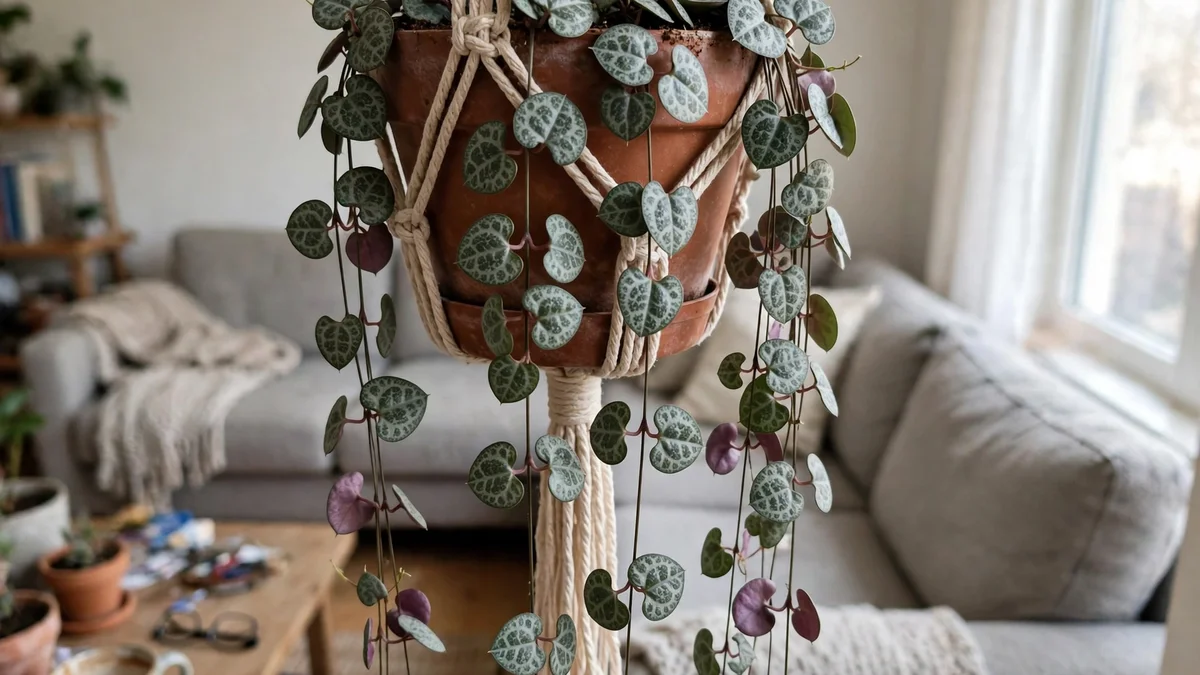
1. Classic String of Hearts
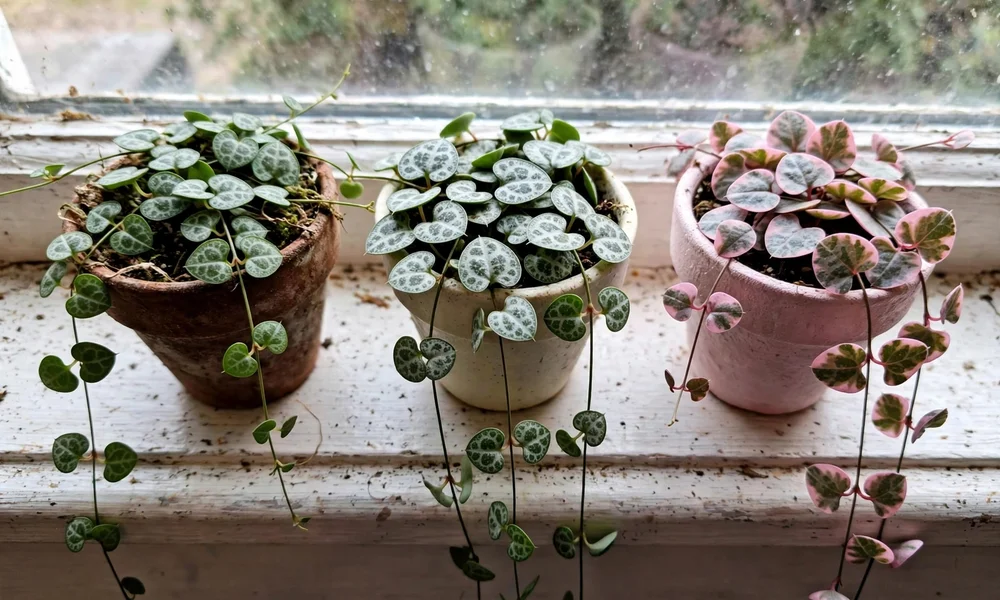
The original, Ceropegia woodii, and still the best place to start. Small heart-shaped leaves in dark green, marbled with silver, with purple undersides that show as the vines trail. It grows fast in bright indirect light, tolerates a missed watering, and can reach two metres long in a couple of years. Difficulty: easy. If you only grow one, grow this one — and once it gets long, our guide to string of hearts propagation shows how to turn the trimmings into new plants.
2. Variegated String of Hearts
Variegata is the classic with a pink and cream twist. The leaf edges and centres are splashed with white and soft pink, and the pink deepens in bright light. It grows a little slower than the green form because the pale patches have less chlorophyll, and it needs brighter light to keep its colour. Difficulty: easy to moderate. Keep it out of harsh midday sun, which can scorch the pale leaves.
3. Silver Glory
Silver Glory looks dusted with frost. The leaves are mostly silvery-white with a faint green pattern, so the whole plant reads pale and shimmery from a distance. It is one of the prettiest varieties for a light-coloured room, and it holds its silver colour best in bright indirect light. Difficulty: moderate — it is slower growing and sulks if it stays wet.
4. Orange River
Orange River trades green for warm peach and copper. In strong light the heart-shaped leaves flush orange, apricot and rose, with the colour strongest on new growth. It is a sun-lover by string of hearts standards, so give it the brightest spot you have short of direct midday sun. Difficulty: moderate. In low light it fades back to plain green, so the colour is a good gauge of whether it is getting enough light.

5. String of Spades
String of spades has the same trailing habit, but the leaves are pointed and spade-shaped rather than rounded hearts. The foliage is usually a deeper green with silver veining, and the plant looks a little bolder and more graphic than the classic. It grows at a similar pace and wants the same bright indirect light. Difficulty: easy. A good pick if you love the vine but want something that looks a little different at a glance.
6. String of Arrows
String of arrows is the narrow-leaf form, with slim, pointed leaves that give the vine a finer, more delicate look. It trails just as freely, but the texture is lighter, so it suits a small pot on a shelf where a fuller variety would look heavy. Give it bright indirect light and water only when the soil is dry. Difficulty: easy to moderate.
7. String of Needles
String of needles, Ceropegia linearis, is a close relative with long, needle-thin leaves on wiry stems. From a distance it looks almost leafless, like a tangle of fine green threads, and it makes a striking contrast next to a leafy classic string of hearts. It likes the same free-draining soil and light watering. Difficulty: easy. It is tougher than it looks and forgives a forgotten watering better than most.
8. Marbled String of Hearts
The marbled form sits between the classic and Silver Glory: green leaves heavily patterned with silver, so no two leaves look quite alike. It is less extreme than a fully silver variety, which makes it easier to keep happy, and the patterning stays strong even in ordinary indoor light. Difficulty: easy. This is the one to choose if you want the silver look without the slower growth of Silver Glory.

9. Purple-Leaf String of Hearts
Some string of hearts plants flush deep purple on the leaf undersides and stems, especially in bright light or cool conditions. Sold as a purple-leaf form, it is really the classic plant showing its colours at their strongest, but the effect is dramatic: green and silver on top, rich purple underneath. Difficulty: easy. The more light it gets, within reason, the stronger the purple.
10. Parachute Plant
Ceropegia sandersonii, the parachute plant, is a cousin rather than a true string of hearts, but it belongs in any Ceropegia collection. It has fleshy green leaves and extraordinary parachute-shaped flowers in pale green and cream. It climbs rather than trails, so give it a small trellis or let it wind around a hoop. Difficulty: moderate. It wants bright light and a light hand with water, just like its trailing relatives.
11. Bushman’s Pipe
Ceropegia ampliata, known as bushman’s pipe, is another cousin, with smooth, leafless-looking stems and odd pipe-shaped flowers. It is a curiosity plant: the stems do most of the work, twining and trailing, and the flowers are the reward. It needs very free-draining soil and bright light. Difficulty: moderate. Best for a collector who already has the classic forms and wants something stranger.
12. Serpent Ceropegia
Ceropegia stapeliiformis, the serpent ceropegia, has thick, snake-like stems with tiny leaves that drop early, so the plant is mostly stem — segmented, grey-green, and faintly striped. It trails and climbs, and in summer it produces small starry flowers. Difficulty: moderate. It is the most unusual plant on this list, and the one most likely to start a conversation.
How to Choose
If you are buying your first string of hearts, start with the classic or the marbled form: both are fast, forgiving and cheap. Add a variegated or Silver Glory plant next, once you have a bright spot for it, and save Orange River for your sunniest window. The three cousins at the end — parachute plant, bushman’s pipe and serpent ceropegia — are for collectors who want the same genus in a wilder form. Whichever you pick, they all want the same things: bright indirect light, free-draining soil, and water only when dry. String of hearts also pairs beautifully with other trailers, so if you like this look, browse our roundup of trailing succulents and our guide to trailing indoor house plants for more hanging-basket ideas.