A string of hearts that has grown long and leggy is not a problem — it is free plants waiting to happen. This trailing vine roots so readily that one healthy mother plant can fill several pots in a single season. Here are the three reliable ways to do it, step by step.

When to Propagate a String of Hearts
Spring and early summer are the best times. The plant is actively growing, daylight is long, and cuttings root in two to four weeks instead of dragging on for months. Winter propagation is possible, but rooting is slower and rot is far more likely because the plant is barely growing.
The other good moment is when your plant gets straggly. Long bare vines with leaves only at the tips are the classic sign that it is time to prune and propagate. The cuttings can go back into the mother pot to fill it out, or into new pots as gifts. Only propagate from a healthy plant — our rosary vine plant care guide covers what a thriving mother plant needs. Take cuttings from firm, green vines with plump leaves, and skip any vine that is yellowed, mushy, or dried out.
What You Will Need
- Clean, sharp scissors or pruning shears, wiped with rubbing alcohol
- A jar of room-temperature water, or small pots of free-draining cactus or succulent mix
- Bobby pins or small pieces of bent wire, for the butterfly method
- Small pots with drainage holes for potting up rooted cuttings
- Rooting hormone powder (optional)
Before you cut anything, learn to spot a node: the small bump on the stem where a pair of leaves grows. Roots sprout from nodes, never from the smooth stem between them, so every cutting must include at least one node — two is better.
Method 1: Stem Cuttings in Water
Water propagation is the easiest method, and the most satisfying, because you can watch the roots grow.
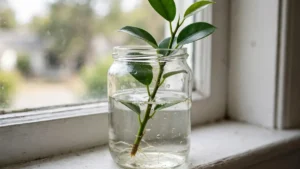
Cut just below a node, leaving a cutting about 4 to 6 inches long with two or three pairs of leaves. Strip off the lowest pair so at least one node sits bare. Stand the cutting in a jar of room-temperature water so the bare node is submerged and the leaves stay dry above the waterline — leaves sitting in water rot fast and foul the jar.
Place the jar in bright, indirect light. Change the water every three to four days to keep it fresh. White root nubs usually appear within one to two weeks, reaching an inch long by week three or four. Pot the cutting up once the roots are an inch or two long.

Method 2: Stem Cuttings in Soil
Soil propagation skips the transplant shock of water rooting, because the roots grow in soil from day one.
Take cuttings the same way as for water — 4 to 6 inches long, with at least one bare node. Dip the cut end in rooting hormone if you have it. Fill a small pot with damp cactus or succulent mix, poke a hole with a pencil, and push the bare node about an inch deep. Firm the soil gently and water lightly.
Keep the soil lightly damp, never soggy. A clear plastic bag tented over the pot holds in humidity and speeds rooting, but lift it every couple of days for fresh air or mould will follow. Tug the cutting gently after three weeks: resistance means roots have formed. New leaves at the tip are the surest sign of success, usually by week four or five — our beginner guide to propagating indoor plants has more detail on this method.
Method 3: The Butterfly Method
The butterfly method is the fastest way to turn one long vine into many plants at once. Instead of cutting the vine into pieces, you lay it across the soil surface and pin each leaf pair down so every node roots while still attached to the mother plant.
Fill a shallow pot or tray with damp, free-draining mix. Lay a healthy vine across the surface in a gentle spiral. At each pair of leaves, press the node lightly into the soil and pin it down with a bobby pin or bent wire, leaving the two leaves on top of the soil.
Mist the soil every few days to keep the nodes damp. Within two to three weeks, roots form at the pinned nodes and tiny new shoots push up. Once each section has roots and a new shoot, usually after four to six weeks, snip the vine between sections.

Propagating From Tubers
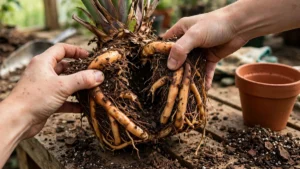
Mature plants grow small, round, beige tubers along their vines — they look like tiny potatoes. They are the easiest propagules of all.
When you spot a tuber, lay that section of vine across damp soil in a small pot, just as in the butterfly method, and pin it gently so the tuber touches the mix. Keep the soil lightly damp. The tuber sends out roots within two to three weeks, and a new shoot usually follows soon after.
Potting Up Rooted Cuttings
Move water-rooted cuttings into soil once the roots are one to two inches long. Use a 3- or 4-inch pot filled with cactus or succulent mix, and plant the cutting at the same depth it sat in the water. Water it in well, then let the top inch of soil dry before watering again.
For soil-rooted cuttings and butterfly sections, wait until you see new growth before moving them, and disturb the roots as little as possible. Plant three or four cuttings together for a full plant faster.

Timeline: What to Expect
- Week 1–2: root nubs appear at nodes in water; in soil, nothing visible yet — this is normal.
- Week 3–4: water roots are ready to pot; soil cuttings resist a tug; butterfly shoots appear.
- Week 5–6: new leaves grow at the tips; butterfly sections can be snipped apart and potted up.
- Month 3–4: vines trail over the pot edge.
Common Failures and How to Fix Them
Cuttings rotting in water. The water is stale or leaves are submerged. Change the water every three to four days, keep all leaves above the waterline, and trim any mushy stem back to firm tissue.
Cuttings rotting in soil. The mix is staying wet. String of hearts is a semi-succulent and rots fast in soggy soil. Let the top inch dry between waterings, use a cactus mix with plenty of perlite, and make sure the pot drains freely.
Cuttings shrivelling instead of rooting. The air is too dry or the light is too strong. Move the cutting out of direct sun into bright, indirect light, and tent a clear bag over soil cuttings to hold in humidity.
Once your cuttings are potted and growing, treat them like young string of hearts plants: bright, indirect light, water only when the top inch or two of soil is dry, and a half-strength feed once a month in spring and summer. Pinch young vine tips to encourage branching. For display ideas once those vines get long, see our round-up of the best trailing plants for hanging baskets.