

Key Takeaways
- NPK Fertilizer means nitrogen, phosphorus, and potassium.
- The numbers always appear in the order N-P-K.
- 10-10-10 and 20-20-20 are both balanced 1:1:1 fertilizers.
- 20-20-20 is twice as concentrated as 10-10-10.
- Higher numbers do not automatically mean a better fertilizer.
- Nitrogen supports leafy growth, while phosphorus and potassium support other important plant processes.
- Soil testing can help determine which nutrients your plants actually need.
- Always follow the product label for application rates.
Quick Answer
NPK stands for nitrogen, phosphorus, and potassium. The three numbers on a fertilizer label show the percentage by weight of nitrogen, available phosphate expressed as P₂O₅, and potash expressed as K₂O, in that order.
For example, 10-10-10 fertilizer contains 10% nitrogen, 10% phosphate, and 10% potash by weight. A 50-pound bag therefore contains 5 pounds of each listed nutrient component.
A 20-20-20 fertilizer has twice the concentration of a 10-10-10 product. Therefore, you generally need less 20-20-20 to provide the same amount of each nutrient.
What Does NPK Mean in Fertilizer?
NPK is short for nitrogen, phosphorus, and potassium, three primary nutrients that plants need in relatively large amounts.
Although plants require many other nutrients, these three are commonly highlighted on fertilizer labels because they play major roles in plant growth.
| NPK Nutrient | What It Supports |
|---|---|
| N – Nitrogen | Leaf and stem growth, chlorophyll and overall vegetative growth |
| P – Phosphorus | Root development, energy transfer and reproductive growth |
| K – Potassium | Water regulation, plant function and stress tolerance |
Importantly, the numbers do not mean that every plant needs equal amounts of these nutrients. Instead, they tell you the concentration in that particular fertilizer.
A soil test can help determine which nutrients your soil actually needs before you apply fertilizer.
What Do the Three Fertilizer Numbers Mean?

The numbers always appear in the same order:
N – P – K
The first number represents nitrogen. The second represents phosphate, traditionally expressed as P₂O₅ on fertilizer labels. The third represents potash, traditionally expressed as K₂O.
So, a fertilizer labeled 10-10-10 has:
- 10% nitrogen
- 10% phosphate
- 10% potash
Meanwhile, 20-20-20 has:
- 20% nitrogen
- 20% phosphate
- 20% potash
The important point is that these percentages are based on the weight of the fertilizer product, not the percentage of pure elemental phosphorus and potassium.
What Does 10-10-10 Fertilizer Mean?
A 10-10-10 fertilizer is commonly described as a balanced fertilizer because all three listed NPK numbers are equal.
For example, a 50-pound bag contains 5 pounds of nitrogen, 5 pounds of P₂O₅, and 5 pounds of K₂O.
However, balanced does not automatically mean perfect for every plant.
If your soil already contains plenty of phosphorus and potassium, repeatedly using a balanced fertilizer can add nutrients that your plants may not need. Therefore, soil conditions and plant requirements should guide your choice.
What Does 20-20-20 Fertilizer Mean?
20-20-20 is also a balanced fertilizer, but it is more concentrated than 10-10-10.
A 50-pound bag contains 10 pounds each of nitrogen, P₂O₅, and K₂O.
Consequently, 20-20-20 can provide approximately the same amount of listed NPK nutrients as twice as much 10-10-10.
For example:
| Fertilizer | Amount Used | Nitrogen |
| 10-10-10 | 10 lb | 1 lb |
| 20-20-20 | 5 lb | 1 lb |
The same relationship applies to the listed phosphate and potash.
10-10-10 vs 20-20-20 Fertilizer
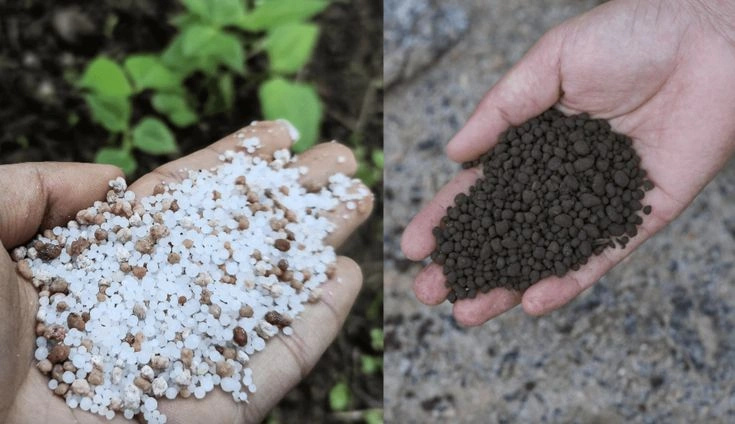
The biggest difference between these fertilizers is concentration, not the basic NPK ratio.
Both have a 1:1:1 ratio. However, 20-20-20 contains twice as much of each listed nutrient per unit of fertilizer.
| Feature | 10-10-10 | 20-20-20 |
| Nitrogen | 10% | 20% |
| Phosphate | 10% | 20% |
| Potash | 10% | 20% |
| NPK ratio | 1:1:1 | 1:1:1 |
| Concentration | Lower | Higher |
| Amount needed for same nutrient quantity | More | Less |
| Best choice | Depends on soil and plant | Depends on soil and plant |
Therefore, it would be a mistake to assume that 20-20-20 is automatically better simply because the numbers are higher.
The fertilizer analysis tells you how concentrated the product is. It does not tell you whether your plant actually needs more nutrients.
What Does Nitrogen Do for Plants?
Nitrogen is strongly associated with leafy, vegetative growth. It is also an essential part of chlorophyll and proteins.
When plants have an appropriate nitrogen supply, they can produce healthy new growth. On the other hand, too much nitrogen can encourage excessive soft growth in some plants.
For this reason, more nitrogen is not always better.
Nitrogen can also move through soil relatively easily, so it often needs to be replenished depending on the crop, soil and growing conditions.
What Does Phosphorus Do for Plants?

Phosphorus is involved in important plant processes, including energy transfer and root development.
It is especially important to understand that adding extra phosphorus does not automatically produce better roots or flowers. If soil already contains sufficient phosphorus, additional applications may be unnecessary.
In fact, extension guidance recommends using soil-test information when deciding whether phosphorus should be added.
What Does Potassium Do for Plants?
Potassium is the third number in an NPK fertilizer.
It plays an important role in plant water regulation and several physiological processes. Adequate potassium also supports normal plant function under environmental stress.
Nevertheless, plants should not receive potassium simply because a fertilizer contains it. A soil test can help identify whether potassium is actually needed.
Is 20-20-20 Better Than 10-10-10?
No. 20-20-20 is not automatically better than 10-10-10.
The right choice depends on the plant, growing medium, soil fertility, and recommended application rate.
For example, if you need to supply a certain amount of nitrogen, a 20-20-20 fertilizer may require less product than 10-10-10. However, if using the higher-concentration fertilizer results in too much phosphorus or potassium for your soil, it may not be the best choice.
Therefore, always follow the product label and, when possible, use a soil test to guide fertilizer selection.
How to Calculate Nutrients in NPK Fertilizer
The calculation is simple.
Suppose you have 10 pounds of 10-10-10 fertilizer.
The nitrogen calculation is:
10 × 0.10 = 1 pound of nitrogen
The same calculation gives 1 pound of P₂O₅ and 1 pound of K₂O.
Now consider 10 pounds of 20-20-20:
10 × 0.20 = 2 pounds
So, 10 pounds of 20-20-20 provides twice as much of each listed component as 10 pounds of 10-10-10.
Penn State Extension recommends calculating fertilizer quantities from the nutrient percentage and the actual nutrient requirement rather than simply choosing a fertilizer because its numbers look higher.
Does a Higher NPK Number Mean Stronger Fertilizer?
Yes, in terms of nutrient concentration, a higher number means more of that listed nutrient by weight.
However, “stronger” does not mean “better.”
For instance, 20-20-20 is more concentrated than 10-10-10. As a result, using the same amount of both products would not provide the same quantity of nutrients.
This is why application rates matter. Using a concentrated fertilizer at an excessive rate can cause problems for plants and soil.
How to Choose the Right NPK Ratio
The best NPK ratio depends on what your plant and soil require.
Start With Your Soil
First, consider a soil test when one is available. It can show nutrient levels and other useful information such as soil pH.
Next, look at the fertilizer recommendation rather than choosing a product based only on its packaging.
Consider the Plant
Different plants have different nutritional requirements. A leafy vegetable, flowering plant, lawn and fruit tree may not require the same fertilizer program.
Therefore, avoid treating one NPK ratio as a universal solution.
Follow the Label
Finally, use the manufacturer’s directions for application rate, timing and method.
A concentrated product can require a much smaller amount than a lower-analysis fertilizer. Consequently, guessing the dose can lead to overapplication.
Common NPK Fertilizer Mistakes
Assuming Balanced Means Best
A 10-10-10 or 20-20-20 fertilizer provides equal listed NPK concentrations, but that does not mean every plant needs equal amounts.
Using More Because Plants Look Unhealthy
Yellowing, poor growth or leaf damage does not always mean the plant needs fertilizer.
Problems such as incorrect watering, unsuitable light, pests, diseases, poor drainage or pH issues can also affect plant health.
Comparing Fertilizers Only by Price
A cheaper fertilizer may have a lower nutrient concentration, while a more expensive product may be more concentrated.
Instead, compare the nutrient analysis and the amount required for your plants.
Applying Fertilizer Without Checking the Soil
Repeatedly adding nutrients without knowing what is already present can waste money and may contribute to nutrient buildup.
Soil testing is a much better starting point when it is practical.
10-10-10 vs 20-20-20: Which One Should You Use?
There is no single winner.
Choose 10-10-10 when a lower-concentration balanced fertilizer fits the recommendation for your soil and plants.
Choose 20-20-20 when a higher-concentration balanced product is appropriate and the label directions support its use.
Above all, remember that NPK fertilizer is a tool, not a universal plant food formula. Your plant’s needs and the condition of your soil should come first.
NPK Fertilizer Checklist
-
Check the three NPK numbers on the label.
-
Remember that the order is N-P-K.
-
Check whether your soil actually needs fertilizer.
-
Consider a soil test when possible.
-
Match the fertilizer to the plant’s needs.
-
Follow the product’s application instructions.
-
Do not assume higher numbers are better.
-
Avoid applying extra fertilizer just because a plant looks unhealthy.
-
Keep fertilizer away from areas where it could be washed into waterways.
-
Recheck plant growth before applying another dose.
Frequently Asked Questions
Is 10-10-10 fertilizer good for all plants?
No. 10-10-10 can be useful in situations where a balanced fertilizer is appropriate, but plants do not all have identical nutrient requirements.
What is the difference between NPK 10-10-10 and 20-20-20?
Both have a 1:1:1 NPK ratio. However, 20-20-20 contains twice the concentration of each listed nutrient compared with 10-10-10.
Can I use 20-20-20 instead of 10-10-10?
Sometimes, but you cannot simply use the same quantity. Because 20-20-20 is more concentrated, the appropriate amount may be lower. Always follow the fertilizer label and the nutrient recommendation for your plants.
Which NPK is best for flowering plants?
There is no single NPK ratio that is best for every flowering plant. A fertilizer should be selected according to the plant’s requirements and the nutrient levels in the growing medium or soil.
What does NPK stand for?
NPK stands for nitrogen, phosphorus, and potassium. These are the three primary nutrients shown in the standard fertilizer analysis.
Does 20-20-20 mean 20% of each nutrient?
The label indicates 20% nitrogen, 20% available phosphate expressed as P₂O₅, and 20% potash expressed as K₂O by weight.
Can too much fertilizer hurt plants?
Yes. Applying more fertilizer than needed can cause nutrient problems and may damage plants. Furthermore, excess nutrients can contribute to environmental problems, which is why soil testing and proper application rates are important.
Conclusion
Understanding NPK fertilizer numbers makes the fertilizer aisle much less confusing. Once you know that the three numbers represent nitrogen, phosphate and potash in that order, products such as 10-10-10 and 20-20-20 become much easier to compare.
Most importantly, do not choose fertilizer simply because it has bigger numbers. Instead, consider your plant’s needs, soil condition and recommended application rate.
For more practical plant care and gardening guides, Peeacelily can help you build a better understanding of the basics, one gardening topic at a time.