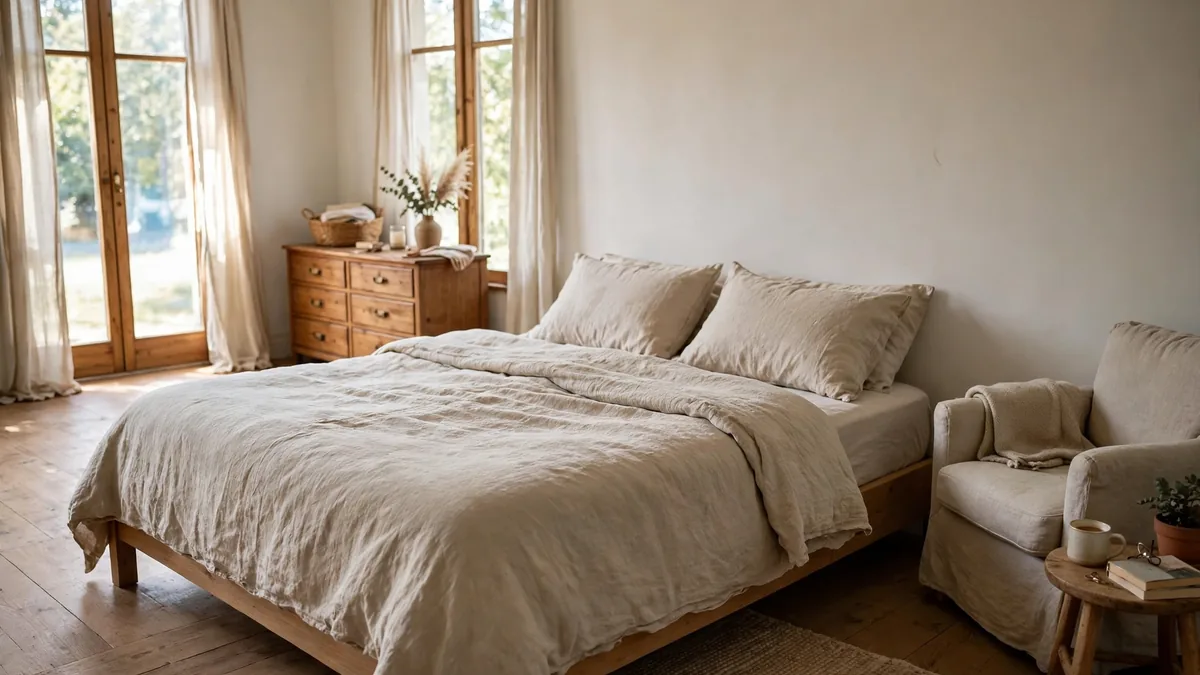
A large bedroom should feel like a luxury, but many of them feel like an empty hall with a bed lost in the middle. The furniture looks small and voices echo. The problem is rarely the size of the room. A big room needs a different plan from a small one: instead of saving space, you have to spend it well. These large bedroom decorating ideas show how to fill the space without cluttering it, so the room feels generous and calm.
Divide the Room Into Zones
Before you buy anything, measure the room and sketch it on paper. Note the door swing, the windows and the wardrobe. A room of 15 by 18 feet or bigger has room for more than a bed. Give every part of it a job.
Think in three zones. The sleep zone holds the bed and bedside tables. The rest zone is a chair or small loveseat with a lamp and a book. The dress zone is the wardrobe, a dresser and a mirror, ideally near the closet. In a very large bedroom you can add a fourth zone, such as a desk, but three is enough to start.
Leave clear paths between the zones. You should be able to walk from the door to the bed and from the bed to the wardrobe without squeezing past furniture. Empty floor in the right places is what makes a big room feel calm, so resist the urge to push everything against the walls.
Scale the Furniture Up, Not the Number of Pieces
The most common mistake in a large bedroom is buying normal-sized furniture and then adding more of it to fill the gaps. The result looks like a furniture shop, not a bedroom. The fix is fewer pieces, each one bigger. A king bed is the obvious starting point. Pair it with a tall headboard, at least 55 inches high, so the bed holds its own against a long wall.
Bedside tables should be wider than the usual 18 inches. Look for tables 24 to 30 inches wide with a drawer, and lamps around 28 to 32 inches tall. A small lamp on a wide table disappears. The same rule applies to the dresser: a long, low dresser of 60 inches or more suits a big wall far better than a tall narrow chest.
If the room still feels bare, add one statement piece rather than five small ones. A bench at the foot of the bed, a large armchair or a wardrobe with real presence will do more than a row of small baskets ever will.
Use Rugs to Anchor Each Zone
In a large bedroom, rugs do the job walls do in a small one: they tell you where each zone begins and ends. A rug that is too small is worse than no rug at all, because it makes the bed look as if it is floating on bare floor. For a king bed, the rug should extend at least 24 inches beyond the bed on both sides and at the foot: 9 by 12 feet or larger. For a queen, 8 by 10 feet.
Each extra zone deserves its own rug too. A smaller rug under the reading chair, roughly 5 by 7 feet, marks the rest zone and keeps the chair from looking stranded. Layering helps too: a large neutral rug underneath with a smaller textured one on top adds warmth without adding furniture. If you are unsure about sizing, the same measuring rules that work in the living room apply here, and our living room rug size guide walks through the numbers.

Layer the Lighting
One ceiling light in the middle of a large bedroom is the fastest way to make it feel like a waiting room. Big rooms need light in layers, at different heights. Start with the ceiling fixture, but make it count: a pendant sized to the room, roughly one inch of diameter for every foot of room width, so a 15-foot-wide room gets a fixture at least 15 inches across.
Then add a lamp in every zone: two bedside lamps, a floor lamp by the reading chair, and a light near the dresser or mirror. Warm bulbs, around 2700K, keep the room soft in the evening, and dimmers are worth fitting on the main light. Sheer curtains soften tall windows without blocking them, and a mirror opposite a window bounces light into the far corners.

Fill the Walls at the Right Scale
Empty walls are the other reason large bedrooms feel unfinished. The mistake is hanging one small picture in the middle of a long wall. One large piece, or a gallery of three to five pieces hung close together, fills it far better.
Hang art so its centre sits at eye level, around 57 to 60 inches from the floor. On a long bare wall, a pair of matching frames, a long low shelf with books and a plant, or a full-length mirror will do more than scattered small frames. A mirror is especially useful here: it reflects light and completes the dressing zone. Do not fill every wall, though. One or two dressed walls and one plain wall is the right balance.
Warm It Up With Colour and Texture
Large rooms swallow pale, flat colour. If the walls, bedding and floor are all the same light neutral, the room can feel cold even in summer. You do not need dark walls to fix it. What matters is contrast and texture.
Layer three or four textures in the sleep zone alone: linen bedding, a wool throw, a velvet cushion, and a wooden or upholstered headboard. Plants help more in a large room than in a small one, because a tall plant fills vertical space that furniture cannot reach. A large peace lily or a tall snake plant in a heavy pot anchors an empty corner without looking like clutter. Keep the palette to three main colours plus one accent, and repeat each colour at least twice. For more ideas on making a bedroom feel inviting, see these cozy bedroom decor ideas, many of which work just as well at a larger scale.

Five Mistakes That Make a Big Bedroom Feel Empty
- Pushing everything against the walls. It leaves a dead empty middle and makes the room feel like a hall.
- Buying small-scale furniture. A standard dresser and 18-inch bedside tables look lost in a big room.
- One rug that is too small. A rug should sit under the front legs of the furniture in its zone.
- One light source. A single ceiling light flattens a large room. Every zone needs its own lamp.
- Leaving the corners empty. A chair, a plant or a floor lamp finishes an empty corner with one move.
Bringing It All Together
Decorating a large bedroom is not about owning more things. It is about giving the room a clear structure: zones with a purpose, furniture scaled to the space, rugs that anchor each area, light at several heights, and walls dressed at the right scale. If you are still choosing the overall look, these master bedroom styles will help you pick a direction.