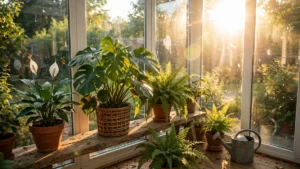
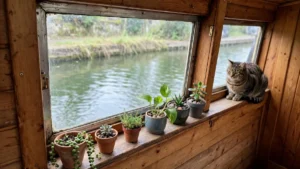
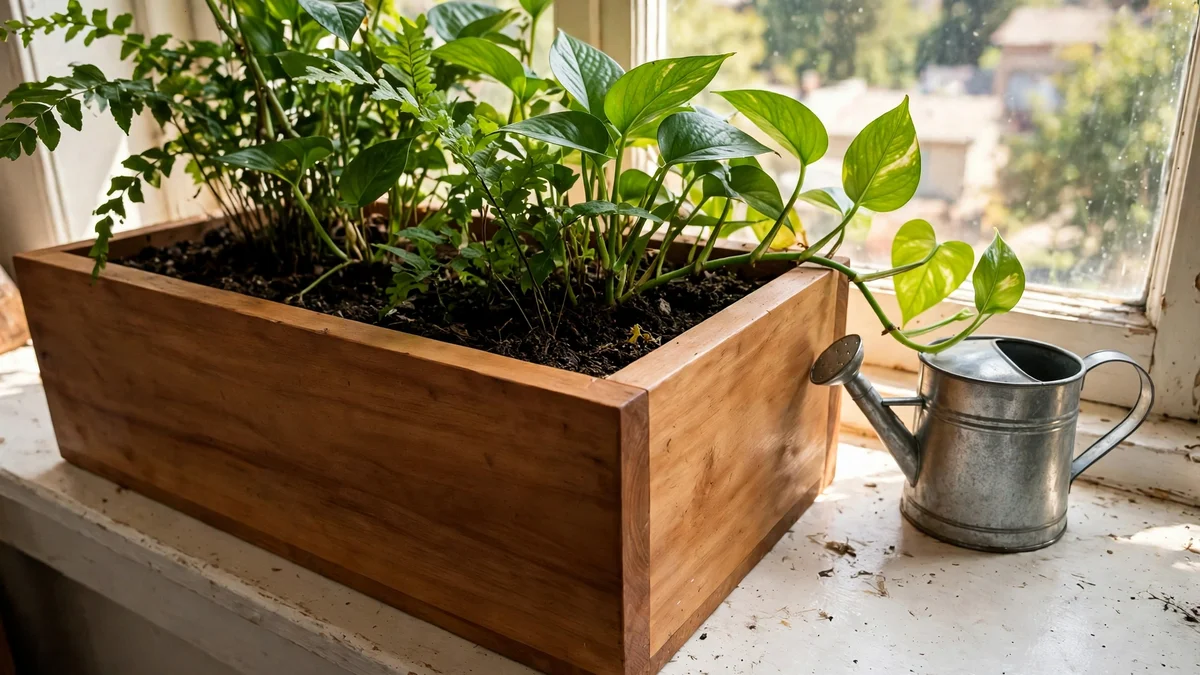
Why would anyone keep their only plants in a tiny house? People ask me that when they step inside and realise the whole house is about the size of a living room, and the plants are standing right there in the middle of everything. There is no spare room for them, no hallway to line with pots. And yet, after years of keeping plants in ordinary houses, the tiny house is the only place I grow them now. Six plants, six pots, in a home that stays exactly where it is. My tiny house does not travel. It sits on its patch of ground through every season, and the plants sit with it, in the same windows, watching the same light change month by month. I chose a home that holds still long enough for something to grow in it.
A House That Stays Put
The first reason is the stillness of the place itself. A tiny house is fixed, not moving. It does not glide down a canal or roll down a motorway; it wakes up in the same spot every morning, facing the same patch of sky. That sounds unremarkable until you have lived with plants in a home that moves, or in a big house where the light changes from room to room and you never quite learn any of it. Here, I know my windows the way you know a neighbour. I know which one catches the first sun in January and which one stays dim until June, and the exact week in spring when the light finally reaches the shelf above the sink. My plants have lived in the same places for years, and they have grown into those places the way a tree grows into a gap in a fence.
The Plants Are the Walls
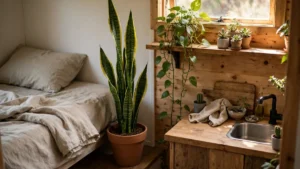
The second reason is what the plants do to the room itself. A tiny house is mostly one open space: kitchen, sitting area, sleeping loft, all of it under one roof with no walls between them. In an ordinary house, walls tell you where one room ends and the next begins. Here, the plants do that job. A tall snake plant stands where a partition would be, marking the edge of the sleeping area without closing anything off. A trailing pothos spills from the shelf above the kitchen counter and draws a green line between cooking and sitting. The plants are not arranged around the room. They are the room, or at least the soft edges of it.
That is why I only grow a few. Six plants are enough to divide a single room and still leave it open, and seven would start to close it in. Every plant here earns its place not by surviving but by doing a job: marking a boundary, softening a corner, filling a vertical gap that would otherwise be bare timber. The picks that work in a house this small are the ones that grow up or trail down instead of spreading sideways, and our roundup of the best plants for a tiny house is where I started when I was choosing them. A plant that sprawls has nowhere to sprawl to. A plant that climbs has the whole height of the room.
The Loft Draws the Line
The third reason is the loft, and it is the reason the collection stays small without me having to be disciplined about it. Hot air rises, and in a tiny house it has nowhere else to go, so the sleeping loft under the roof is the warmest air in the house by a long way. Plants cannot live up there. They would bake slowly through the winter while I slept. So the plants live at living level, at eye height and below, in the part of the house I actually spend my days in.
What I love about that limit is that it is not mine. I do not have to keep telling myself to stop buying plants, because there is simply nowhere to put another one. In a big house, an extra plant goes in the spare room and nobody notices for months. Here, an extra plant would sit on the fold-down table or block the only window, and I would trip over it the same evening. The loft draws the line for me: if a plant cannot live at eye level in the one room I live in, it does not live here.
Off-Grid, Everything Loops
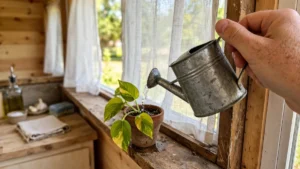
The fourth reason is the way a tiny house runs, because most of them run on what they catch. Mine runs on solar panels and a rainwater tank, and that changes how I think about the plants. They are not separate from the house’s systems. They are part of them. The water I give them comes from the same tank as the water I drink, so I check the soil first and I never water on a schedule. The pots drain into saucers and the saucers get emptied back onto the outdoor beds, not down a drain. Fallen leaves and spent soil go into the compost, and the compost goes back into the pots in spring. Nothing leaves the loop if I can help it. For the practical side of keeping plants in that one warm, low-ceilinged room, our guide to how to care for a plant in a tiny house covers the heat, the dry air, and the light.
Fewer Plants, Longer Relationships
The last reason is the simplest, and it is the one downsizing taught me. When you live with six plants in one room for years, you stop collecting plants and start keeping them. I know which of mine sulks after a cloudy week and which one puts out new growth the moment the light returns in February. There is no plant number twenty-seven here, no pot I water because it happens to be on the way to somewhere else. Every plant is one I chose, in a spot I chose, for a reason I still remember.
That is also why the plants I keep have to be safe for the whole household, not just for me. A tiny house is one room, and my cat shares every inch of it, so a plant on a shelf is a plant within reach of a curious paw. When I was narrowing the collection down, I checked every candidate against our roundup of the best pet-safe plants for a tiny house. Fewer plants, chosen carefully, means every one of them is safe, every one of them is known, and every one of them has been here long enough to matter.
So that is why I only grow plants in my tiny house now. Not because it is the easiest place to keep them. Because it is the place where the plants stay put, where they hold the room together, where the loft keeps the collection honest, and where six plants I have lived with for years mean more than sixty I never really knew. The house is small. The plants are few. And for the first time, I know all of them, and they know this one spot, and that is enough.