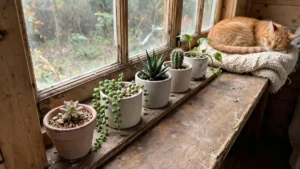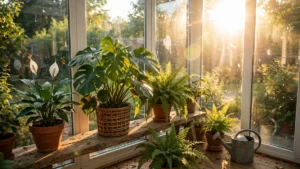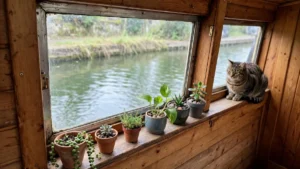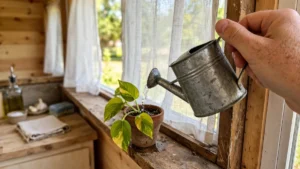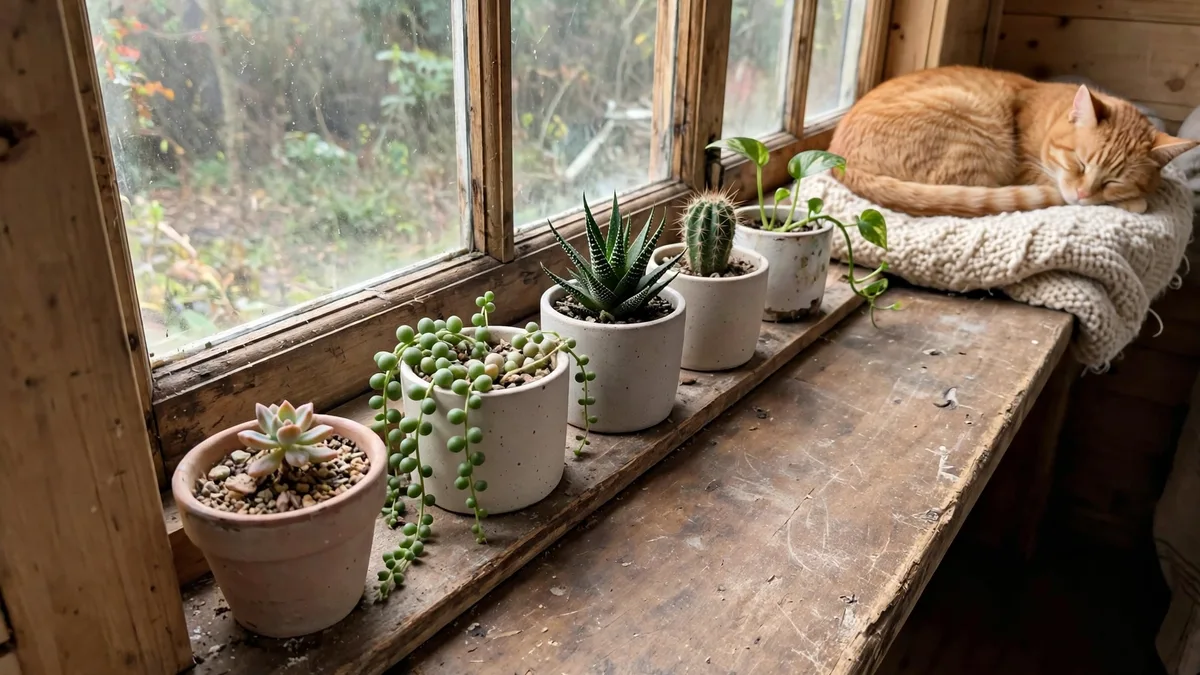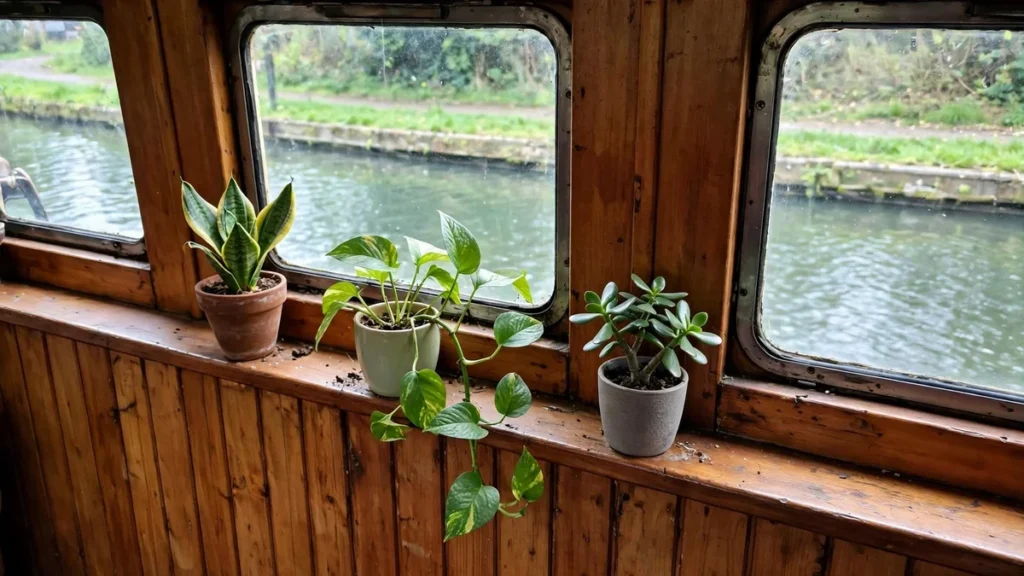
Why would anyone keep their only plants on a narrowboat? People ask me that whenever they duck through the hatch and see the row of pots along the windowsill. A narrowboat is a long steel tube, barely seven feet wide, floating on canal water, warmed by a stove at one end and cooled by the water underneath. It is damp in the morning, dim under bridges, and it gently rocks every time another boat passes. And yet, after years of keeping plants in a house and a garden, the narrowboat is the only place I grow them now. Five plants, five pots, in a home that floats.
I did not arrive at five plants by accident. I arrived there by subtraction. In my old house I had thirty plants spread across every room, and I told myself that made me a plant person. The truth was simpler: the house had space, so I never had to choose. A fern in the spare room faded for months before I noticed. The house let me collect plants without ever really keeping them. The narrowboat took the space away, and with it the excuse. Every plant here has to earn its place, and I finally know all five of them by name and by habit.

The boat is a corridor, not a room
The first reason is the shape of the place itself. A narrowboat is not a room you furnish; it is a corridor you walk through. Mine is close to sixty feet long and less than seven wide, so the plants do not sit in a cluster the way they did in my old living room. They live in a line, one at each window, strung along the length of the boat like stations on a walk: the snake plant by the stove end, the pothos trailing from a shelf halfway down, the jade near the galley, a fern in the washroom, a small succulent at the stern window.
That line changes how I look after them, because I cannot avoid them. In the house, a plant could sit in a room I did not enter for days. On the boat, I walk past every single plant every time I go from one end to the other. A drooping leaf gets noticed the same morning it droops. The boat’s narrowness, the very thing people think would make plant-keeping hard, is what makes it work. There is nowhere for a neglected plant to hide.
The canal sets the pace, not the road
The second reason is the pace of canal life, which is nothing like the pace of the road. A narrowboat is moored far more than it moves. We cruise at walking speed, four miles an hour at most, and often we stay tied up in one spot for days or even weeks. There is no driving day to plan around, no engine vibration, no braking. My plants are not passengers. They are residents of a mooring, and they stay put while the world drifts slowly past the windows.
That stillness suits plants. They are watered on the rhythm of the towpath: a slow morning walk to the water point, a jug filled, the pots done one by one as the kettle boils. Working a lock is the nearest thing to a timetable the canal has, and even that is unhurried. In the house, plant care was a chore I squeezed in. On the boat, it is part of the morning, like checking the mooring ropes.
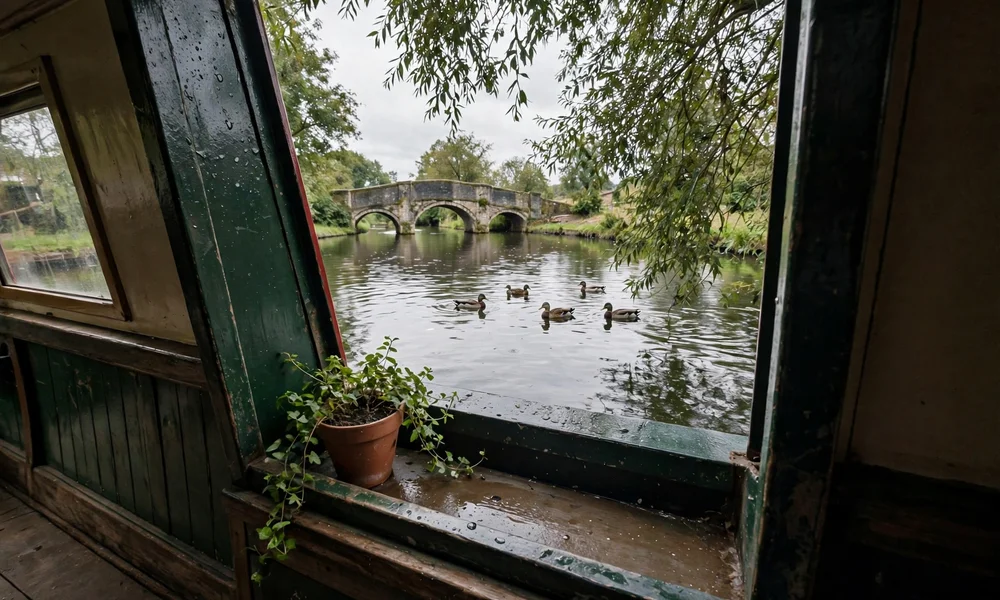
The water itself is part of the arrangement, too. The canal is my garden now — ducks, reeds, overhanging willows, the light shifting on the surface. The plants stay inside, facing that water through the windows. The towpath is my garden, and my five pots are the part of it I bring indoors. Our guide to caring for a plant in a narrowboat explains how the damp and the changing light shape what survives aboard, and it is right about the trade-offs.
Still water, steady plants
Winter taught me the other side of that stillness. The boat barely moves most days, and when it does, it glides, so a pot sits undisturbed for weeks and I choose plants for how they grow rather than for how well they survive being shaken. On a long winter mooring, the stove burns at one end and the far end stays cool, the steel hull sweats with condensation on cold mornings, and the light is thin for months. It is a steady kind of hard, the same every day, and plants cope far better with steady conditions than with changing ones. The snake plant by the stove thrives in the dry warmth, and the fern in the washroom loves the damp. A plant that survives a winter mooring has proved it belongs here. If you are choosing plants for a dim spot, our roundup of the best low-light indoor plants is a good place to start, because low light is the one thing a narrowboat guarantees.
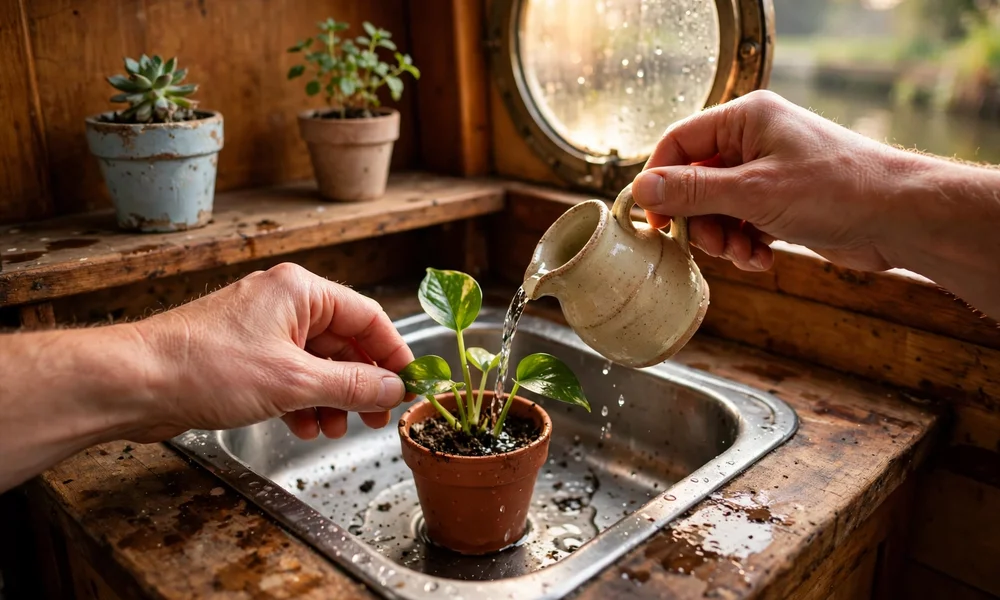
Five plants I actually know
The last reason is the simplest, and it is the one downsizing taught me. Five plants are few enough to know properly. I know the pothos droops a day before it needs water. I know the jade only wants a drink when its leaves soften slightly. I know these things because there are only five of them, and I see each one a dozen times a day as I walk the length of the boat. Thirty plants taught me how to buy plants. Five plants taught me how to keep them.
Letting the other twenty-five go was the hardest part, and it was also the honest part. Giving a plant to a good home is not a failure; keeping it badly is. The ones that stayed are the tough, forgiving ones that suit canal life, and they are all on the list of the easiest indoor plants to take care of for a reason. They forgive a missed watering when I am busy working locks. The boat made me a better plant keeper by being small, slow, and impossible to ignore.

What I would tell anyone thinking about it
If you are thinking about keeping plants on a narrowboat, do not start with ten. Start with two, one for the warm end and one for the cool end, and let them teach you the boat before you add a third. Put them where you will walk past them daily — on a narrowboat, that is everywhere. Water them when you fill the tank, check them when you check the ropes, and accept that the boat will choose some of your plants for you: the ones that love the damp and the dim will stay, and the ones that do not will tell you quickly.
I only grow plants in my narrowboat now because it is the first home that ever made me slow down enough to look at them. The house gave me rooms to fill. The canal gave me a corridor, a mooring, and five plants I finally know. That is not a smaller collection. It is a better one.