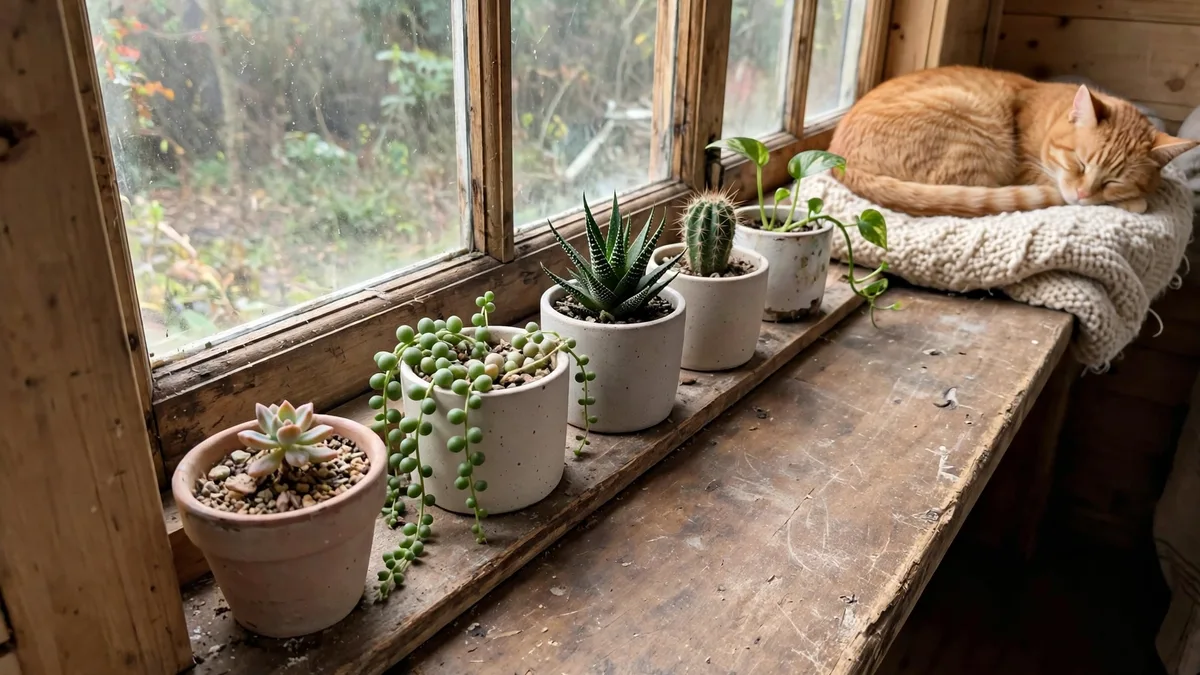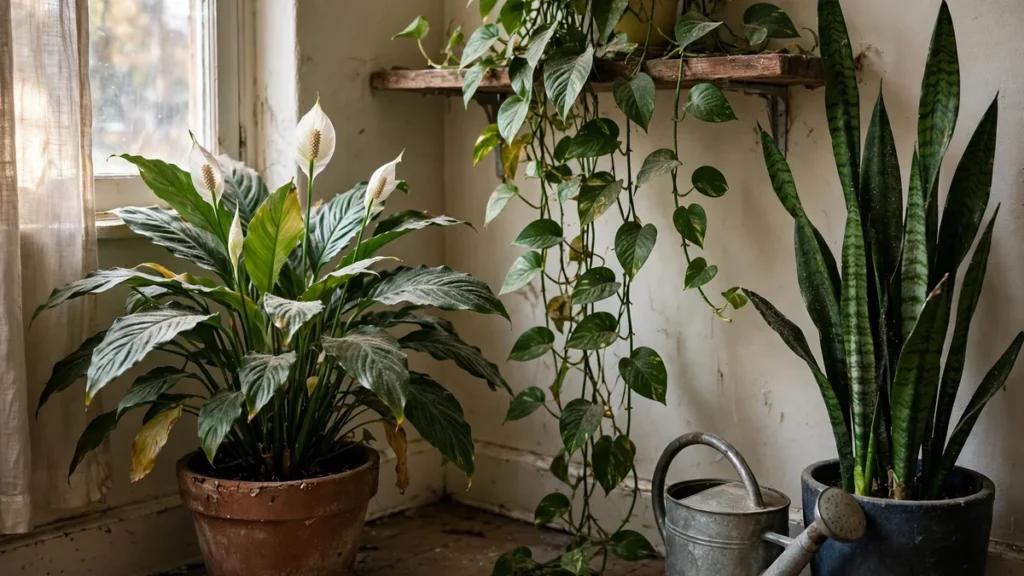
Nineteen years ago, a friend gave me a small pothos for my birthday, and I had no idea what I was doing. Year seventeen taught me to respect the seasons, and year eighteen to look at the room around the plants. Year nineteen has been different again. It was the year I finally fed a plant for the first time, the year I cut the original pothos back harder than I ever had, the year I started writing things down, and the year the radiator taught me something the winter light never had.

The Feed I Finally Tried
The first lesson is the one I am almost embarrassed to admit. I had never fed a plant. Not once, in nineteen years. Water, light, the occasional repot, a Sunday wipe of the leaves — that was the whole routine. They all did well, and I told myself food was something other people worried about.
This spring, though, the peace lily looked tired. The leaves were a paler green than usual, and the flowers were smaller. A friend who grows orchids laughed when I told her I had never fed anything, and she handed me a small bottle of liquid plant food with the words “a little, in spring, that is all.” I did what I thought the bottle said, and a fortnight later the tips of the peace lily’s leaves had gone brown. I had been generous, and generous was the mistake. Our guide on how to care for a peace lily covers the everyday care, but the lesson is about appetite: a plant that has lived on water and light for nineteen years does not need a feast. It needs a little, rarely, and in the growing season only. I flushed the soil and tried again in June at half strength; the new leaves came through a deeper green. Year nineteen taught me that doing without something for nineteen years is not proof you never needed it.

The Cut That Felt Cruel
The second lesson came from the original pothos, the plant that started all of this. After nineteen years it had grown into a long, uneven vine, thick and leafy near the pot and bare for stretches further along, where leaves had fallen years ago and never grown back. I had always trimmed it a stem at a time, trying to keep it looking like the plant it had been. This year I stopped being careful. One Saturday in May I took the scissors and cut it back hard, back to the full green growth near the pot, and left a pile of bare stems on the table that looked, honestly, like I had killed it.
It felt cruel, and for a month it looked cruel too. Then the new growth came, and it came from everywhere at once. By August the pothos was bushier than it had been in years, with fresh leaves along stems that had been bare since long before year ten. The cuttings rooted in water on the kitchen sill in a fortnight. Our guide on how to propagate a pothos shows how one stem becomes a new plant. Year nineteen taught me that a plant I have kept alive for nineteen years can take more than I think it can. Sometimes the kindest thing you can do for an old plant is the thing that looks the least kind while you are doing it.

The Notebook
The third lesson is the quietest, and it is the one that will probably last the longest. In January I bought a small notebook and put it on the windowsill with a pencil, and I started writing one line a week. Not a diary, and not a schedule. Just one line: what I did, and what I noticed. “Fed the peace lily, half strength.” “Cut the pothos back hard.”
It sounds like nothing, and for the first month it felt like nothing. But by summer the notebook had done something nineteen years of memory never had: it had stopped me from repeating myself. When the peace lily looked pale again in September, I did not wonder whether I had fed it too much or too little. I opened the notebook and knew. It even told me the snake plant had put out two leaves in June. Our guide on how often to water indoor plants covers the rhythm, but the notebook covers the remembering, and remembering is the part I had been getting wrong. Year nineteen taught me that after nineteen years, the thing I most needed was not more knowledge. It was a record of what I already knew.

The Radiator
The last lesson arrived with the cold, and it is the one that surprised me most. The snake plant on the landing had lived in the same spot for years, next to the radiator that warms the hall. Every winter it had been fine. This winter it was not. The leaf tips went brown and papery, and one leaf curled at the edge like paper held too close to a fire. I checked the soil and the light, and everything seemed right — until I put my hand above the radiator and felt the dry heat rising straight past the plant.
The radiator had not moved, and the plant had not moved, but the winter had been colder, the heating had been on longer, and the air around that one plant had quietly turned into a desert. I moved the snake plant across the landing, a few feet from the heat, and within weeks the new growth came through clean. Year eighteen taught me that the light in a room changes; year nineteen taught me that the heat does too, and that a plant can be in the right light and the wrong air at the same time. I have spent nineteen years watching windows; this year I learned to watch the radiators too.
What Year Nineteen Really Taught Me
Year nineteen taught me there is still something new to try, something old to cut back, something worth writing down, and something in the house I had never thought to check. I fed a plant for the first time and learned that a little is enough. I cut the oldest plant in the house back hard and learned it could take more than I thought. I started a notebook and learned that remembering is a kind of care. And I moved a plant away from a radiator and learned that winter is not only about light.
Nineteen years on, I keep them the way you keep anything that has been with you a long time: by still trying the obvious thing I had always skipped, by cutting back what no longer works, by writing things down, and by noticing the whole house, heat included. That is what nineteen years gives you that eighteen years could not: the understanding that you are never finished learning from the plants, because the plants, and the house, and you, are all still changing.